 Skip to content

The short version
Every field jacket on sale today is descended from one garment. The M-65 was issued to the US Army from 1965, and it solved a specific problem: one cotton and nylon shell that a soldier could wear in October and in January, carry things in, and pull tight when the wind came up. Four pockets, a drawcord at the waist, a hood rolled into the collar, epaulettes, cuff tabs, and a liner that buttoned in when it got cold.
Sixty years later the shape is everywhere and the engineering mostly isn't. Most of what gets sold as a field jacket has the four pockets and none of the rest, which is fine, because most people buying one are buying the look. It's only a problem when the jacket with two of the six costs more than the jacket with all six.
So we read the product page of every jacket here and counted. Six details, one score out of a hundred, four tiers, and a clear note wherever a brand doesn't publish enough to judge. A low score isn't a bad jacket. It's a jacket doing something else, and on most of these that something else is the whole point.
Start here
What are you actually going to do in it?
This decides the fabric weight and the tier, and it matters a great deal more than the badge on the chest. Pick the honest answer, including the first one.
Pick the one that sounds like you
Each answer opens with what's really going on, what should decide the purchase, and the jackets on this page that do that job.
Fair enough, and it changes what you should spend
The four-pocket military shape is one of the few silhouettes that reads as both rugged and grown up, and most people buying one are buying that and nothing else. There's no shame in it. It just means the technical details are money you won't use.
Buy for the cut and the fabric, and ignore the spec sheet. A cotton twill jacket with four pockets in the right olive will do everything you want for well under two hundred dollars. The waxed and lined ones are heavier, warmer and stiffer than you probably want for standing on a sidewalk.
The checklist
The six details, and who still bothers with them
These are the things the M-65 has. Each one is only counted when the brand publishes it, because a detail you can't confirm is a detail you shouldn't pay for.
Four pockets on the front
The one thing almost everything gets right
What it actually does
Two on the chest, two at the hip, all four big enough for a folded map or a pair of gloves. It's the visual signature of the whole category, and it's the reason a field jacket reads as a field jacket from across a room.
How to spot it
Count them in the product photo. Two chest pockets and two lower pockets is the real thing. Two lower pockets and a chest zip is a jacket wearing the look.
Worth knowing
Eleven of the twelve here have four or more. It's the cheapest detail to copy, which is exactly why it's the one that gets copied.
One scale, twelve jackets
How close each one gets to the real thing
The left end is a jacket following a different pattern altogether. The right end is the M-65 itself, and the gold line is where it sits, because it scores all six.
The gold marker is the M-65
Nothing here is being graded. A dot on the left is a jacket built for a different job, and three of those are among the best things on this page.
The scale is ours. It counts six things the M-65 has, and it counts them only when the brand states them in writing.
The picks
Twelve jackets, three in each tier
Everything here was in stock at full price when we checked, and every price is the one on the page we link. The tiers are kinds rather than a price ladder, so the cheapest jacket on the page turns up in the workwear section and not the budget one.
Under two hundred dollars, and better than that sounds
This is where most people should be shopping, and the surprise of the whole exercise is how well it holds up. One of these three has a hood hidden in the collar, which is a detail two of the expensive jackets on this page don't have. What you give up down here is fabric weight and the removable liner, not the look.
The cheapest thing here, and it earns it
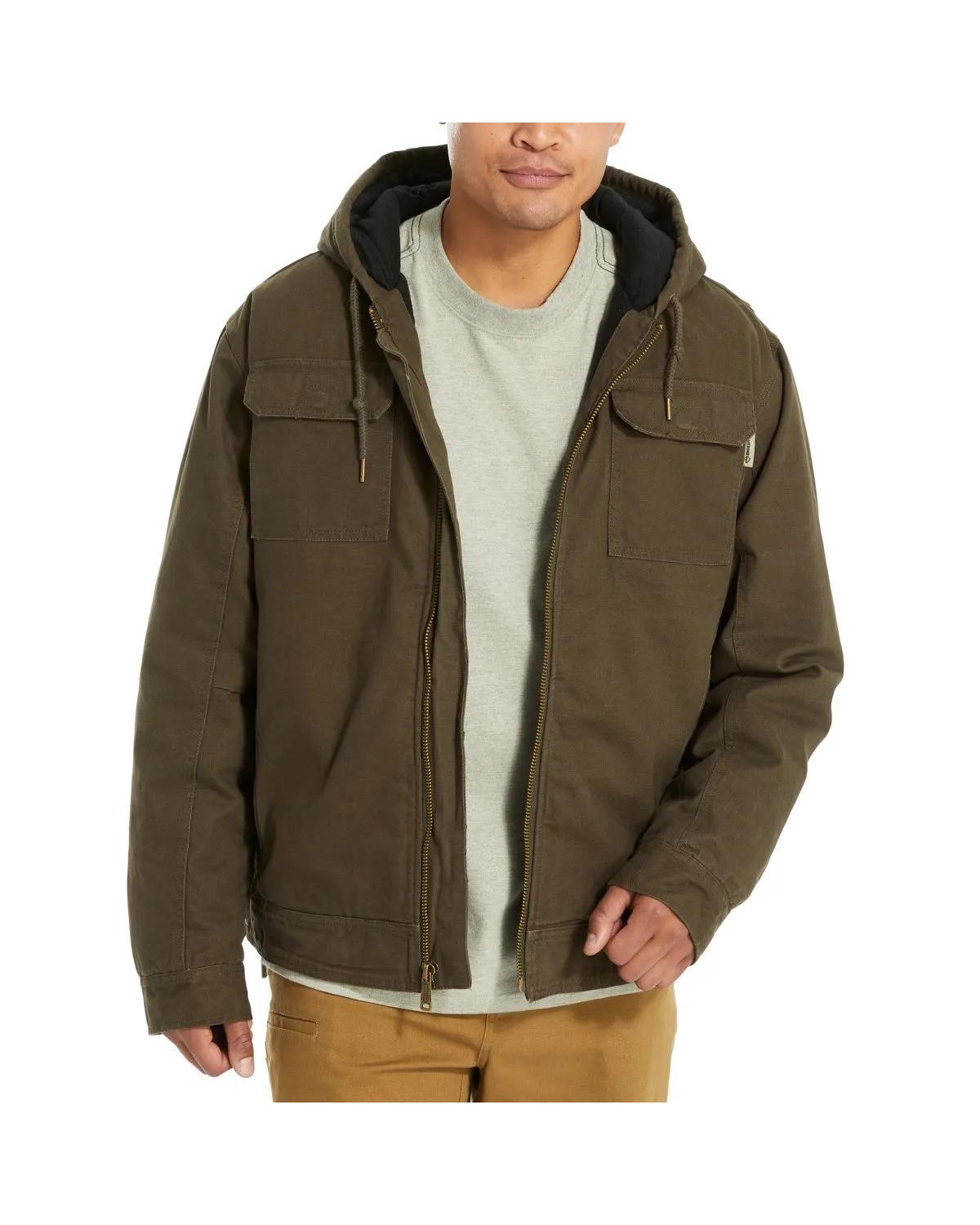
Wolverine Lockhart Jacket
A hundred dollars buys cotton duck canvas, a quilted lining, four pockets and adjustable tab cuffs. Wolverine build this for people who work outside in the cold, so nothing about it is decorative, and the magnetic pocket closures are a genuinely good idea once you've tried opening a snap with gloves on.
It's also the only jacket in this half of the page with a proper hood, and the hood has its own drawcord. If you want one jacket that handles a cold morning and a wet one without thinking about it, this is the least you can spend and still be fine.
A stowaway hood lives in the collar and disappears when you don't want it. This one sits on the back of the jacket permanently, which is why the silhouette reads more workwear hoodie than military. That's a look, and it's a fine one, it's just not the M-65 look.
You want the function at the lowest possible price and you don't care about the cut.
You're buying this for the clean military silhouette. The hood breaks it.
The spec sheet
The spec sheet
Every line here comes from Wolverine. Where a line is missing from this rail, the brand doesn't publish it.
The best-value jacket on the page, by some distance
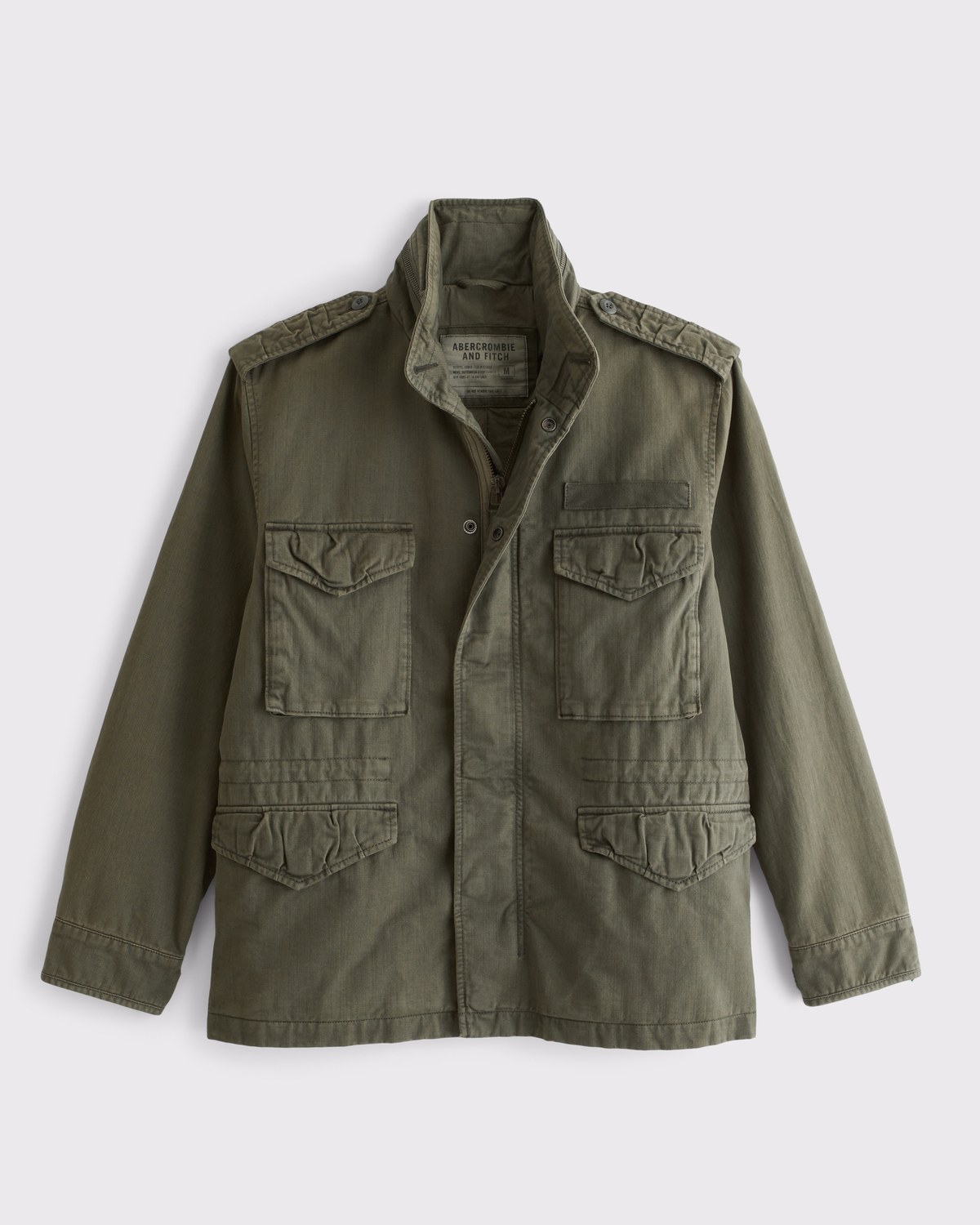
Abercrombie & Fitch Military Jacket
Abercrombie's own copy lists four flap pockets, a front that closes with both buttons and a zip, and a back collar zipper that stores a nylon hood. That last one is the expensive detail on an M-65, and finding it at a hundred and sixty dollars was the biggest surprise of the whole exercise.
It's from their hundred-year archive collection, so the washed twill and the vintage hardware are doing a deliberate impression of an old jacket. The impression is a good one. Nothing about the silhouette gives it away in a photograph.
There's no drawcord, so the fit you get is the fit the pattern gives you. On an intentionally boxy military cut that matters more than it sounds, and it's the main thing separating this from the Alpha jackets further down.
You want the look, properly done, and you'd rather not spend $250.
You need to pull the waist in to make a boxy jacket work on you.
The spec sheet
The spec sheet
Every line here comes from Abercrombie & Fitch. Where a line is missing from this rail, the brand doesn't publish it.
American, not military, and it has been here forever
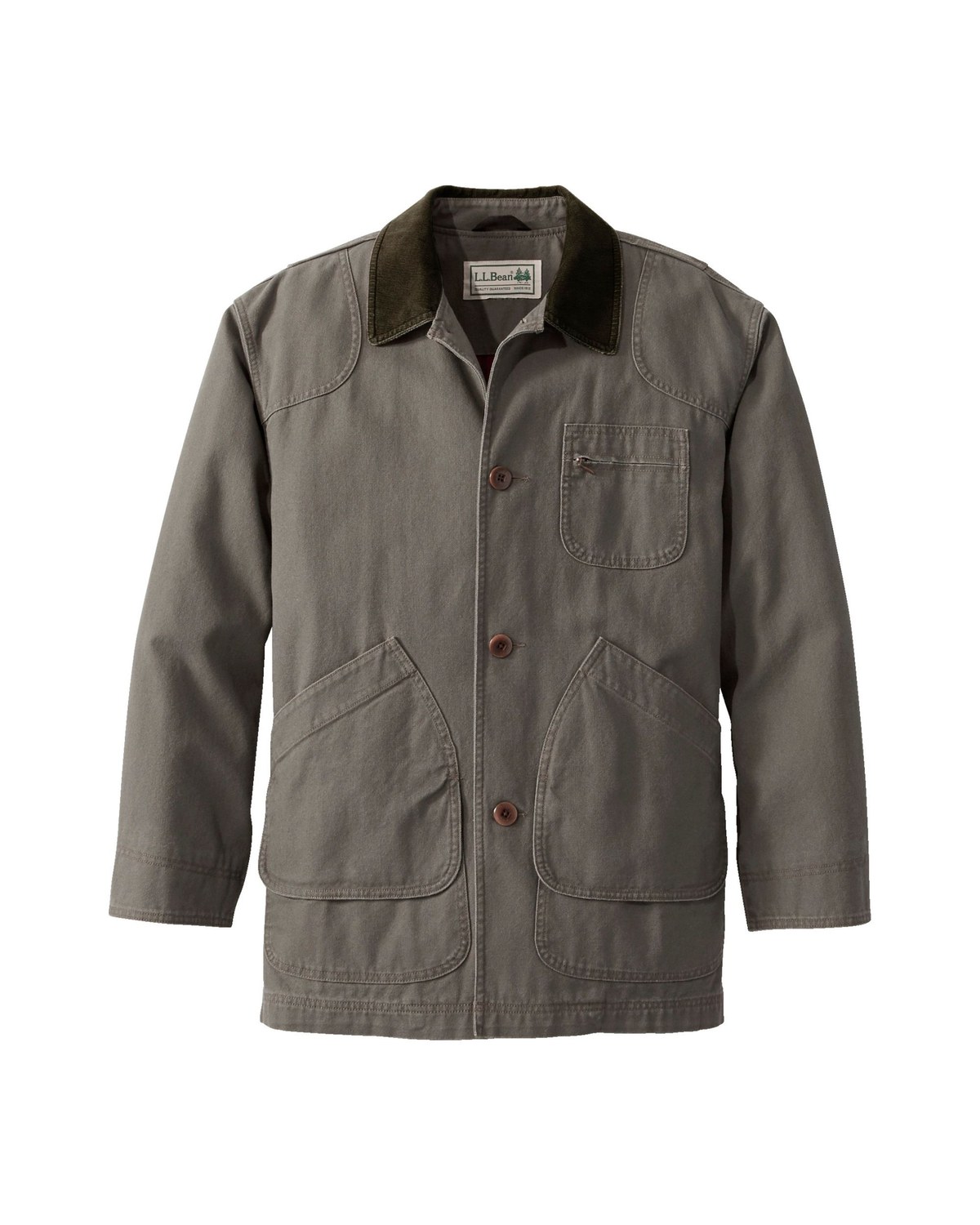
L.L.Bean Original Field Coat
This is the barn coat lineage rather than the army one, and it's the most quietly sensible jacket on the page. Ten ounce cotton canvas, corduroy collar, five pockets, brushed cotton lining, and a cut that falls just below the hip so it works over a sweater without looking like a coat.
It's also the only jacket here offered in regular and tall in five colors, which matters more than any spec on this page if you're over six foot two and tired of sleeves that stop early.
No drawcord, no hood, no removable liner, no epaulettes. Our scale measures how closely a jacket follows the M-65, and this one isn't trying to. It's following a 1920s Maine hunting coat instead, which is a perfectly good thing to follow.
You want a classic American field coat and you're tall or hard to fit.
The military details are the reason you're here.
The spec sheet
The spec sheet
Every line here comes from L.L.Bean. Where a line is missing from this rail, the brand doesn't publish it.
The originals, and the company that still makes the original
Alpha Industries made the M-65 for the US military and still makes it to the same spec, which is why it's the yardstick for this entire page rather than just another pick. The other two here are the American outdoor answer to the same problem, built around waxed cotton and canvas instead of sateen.
The actual M-65, from the company that made it
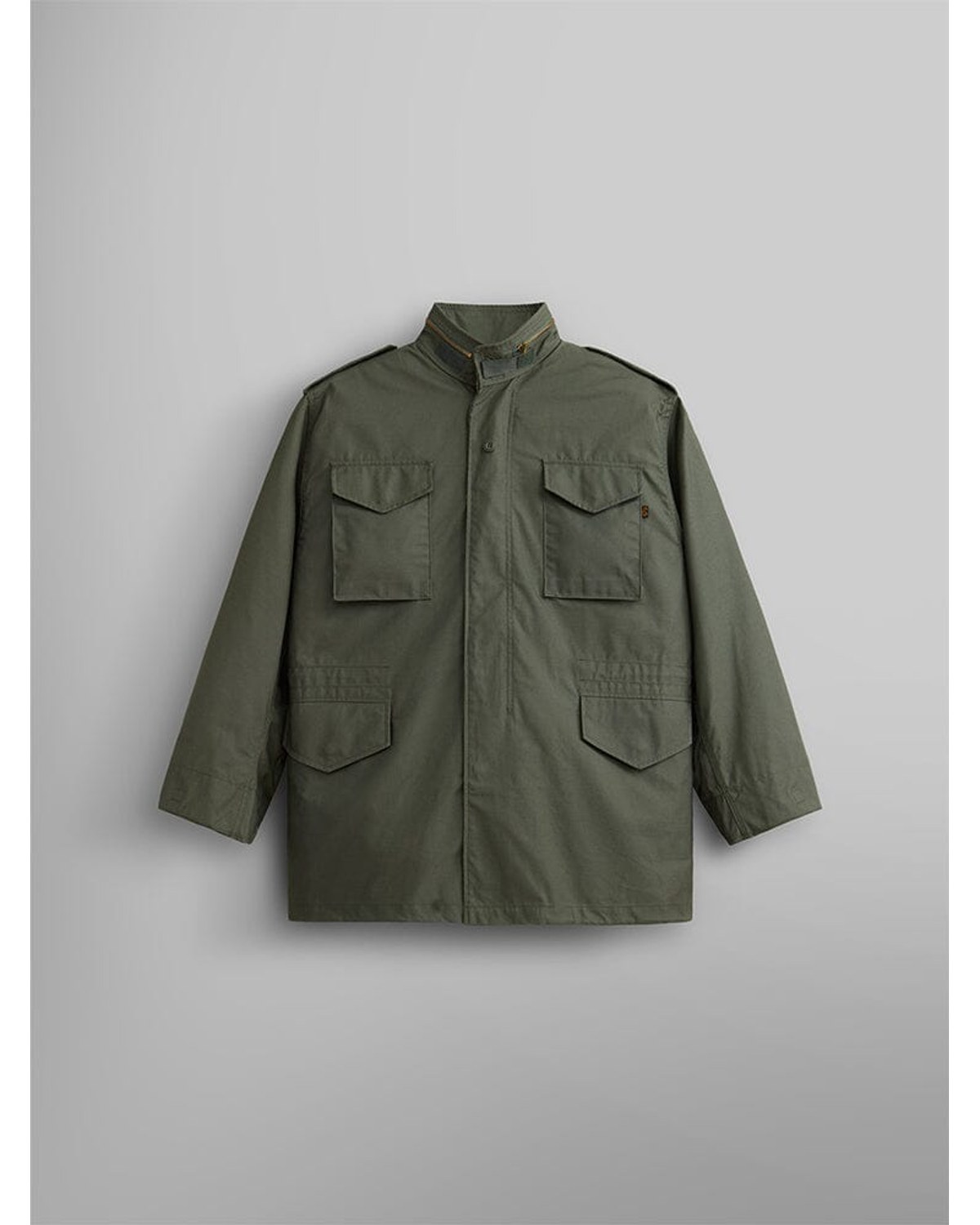
Alpha Industries M-65 Field Jacket
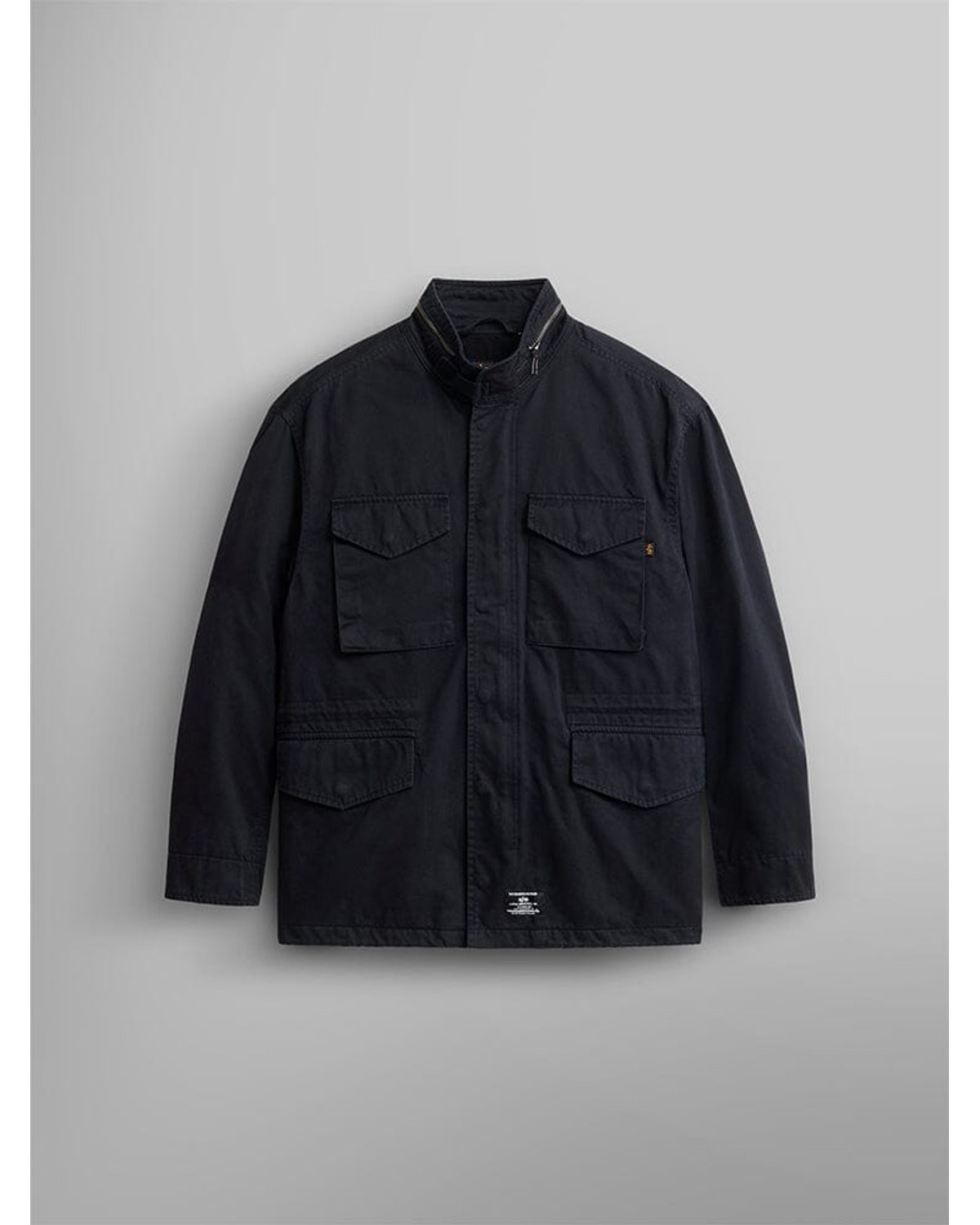
Alpha Industries were an original contractor for the US military M-65, and their own page says this one is manufactured to military specifications. That's not marketing language borrowed from somewhere. It's the reason every other jacket on this page exists, and it's why we've made it the marker on the scale above.
Everything is here: four exterior pockets, a drawstring at the hood, waist and hem, a hood concealed in the collar, buttoned epaulettes, cuff tabs, a bi-swing back and the button-in liner port. Nothing else we looked at publishes all six. Most publish two.
It was cut in 1965 to go over a uniform and webbing, so it's deliberately roomy and Alpha say so up front. Size accordingly. The ALS/92 liner that turns this into a winter coat is a separate purchase, which is worth factoring in before you compare the price with the lined jackets further down.
You want the real one, and you want every detail the others are imitating.
You want a trim modern cut. This isn't that, and it isn't pretending to be.
The spec sheet
The spec sheet
Every line here comes from Alpha Industries. Where a line is missing from this rail, the brand doesn't publish it.
The same company, twenty-five dollars less, half the spec
Alpha Industries M-65 Mod Field Jacket Gen II
This is the most useful comparison on the page, because it's the same brand making the same jacket for a different customer. Alpha list the changes from the previous version themselves: hood removed, garment washed, relaxed fit. It's shorter, softer and it stops above the hip rather than at the thigh.
What survived is the part that changes how it looks on you. Drawstrings at the waist and the hem, four pockets, adjustable cuff tabs. What went is the hood in the collar, the epaulettes and the liner port.
This one comes with its lining sewn in, so it's warmer than the Heritage out of the box and cheaper, but it's one jacket for one temperature range. The Heritage is a shell you add a liner to, which is two jackets for more money.
You want the M-65 look in a cut that works in a city, ready to wear.
You want the hood, the epaulettes or the ability to add a winter liner.
The spec sheet
The spec sheet
Every line here comes from Alpha Industries. Where a line is missing from this rail, the brand doesn't publish it.
The best cloth on the page under three hundred dollars
L.L.Bean 1924 Field Coat
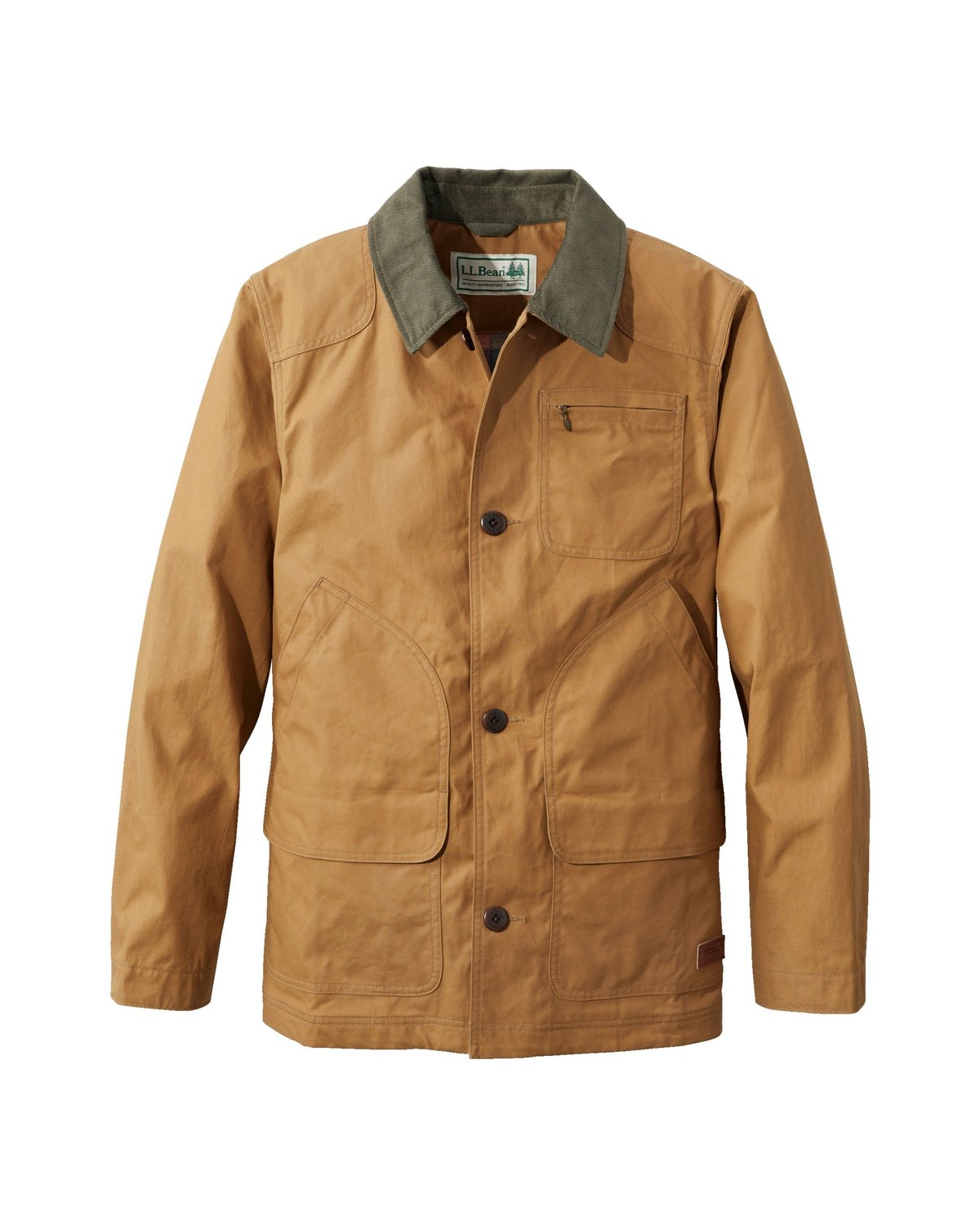
British Millerain is the waxed cotton mill that supplies most of the jackets people think of when they think of waxed cotton, and getting it on a two hundred and fifty dollar coat is a genuinely good deal. The chamois lining is the other half of it, and chamois against the back of your neck in October is a specific and very pleasant thing.
Four flapped utility pockets and a zip chest pocket, corduroy-lined adjustable cuffs, and the same regular and tall size run L.L.Bean run on everything. It's a hunting coat rather than an army one, and it's the one on this page most likely to still be in your closet in fifteen years.
It doesn't breathe, so you'll run warm moving fast, it'll transfer wax onto light upholstery for the first season, and it needs re-waxing every year or two to keep working. People who love waxed cotton consider all of that part of the deal. People who don't should buy the canvas one.
You want serious cloth and a coat that improves with age.
You want to put it on and never think about it again.
The spec sheet
The spec sheet
Every line here comes from L.L.Bean. Where a line is missing from this rail, the brand doesn't publish it.
Bought by people who are going to wreck them
These are sold to tradespeople, and it shows in the fabric weights and in what's been left out. No drawcord waist to snag on a ladder, no epaulettes, nothing decorative. They score lowest on our scale and two of them will outlive everything else here.
Twelve ounce duck with a bit of give in it
Carhartt Rugged Flex Duck Berwick Jacket
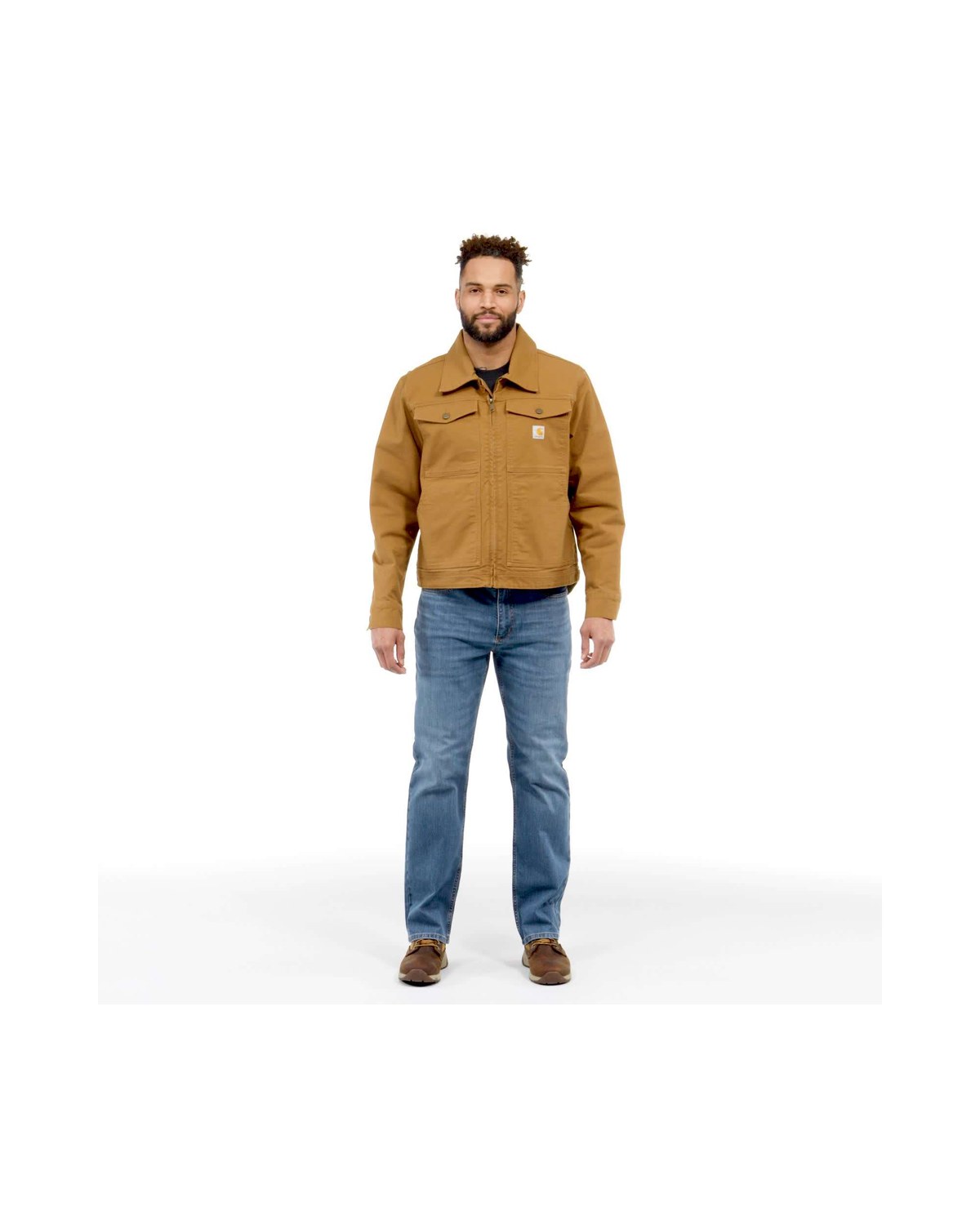
Straight duck canvas is famously stiff for the first month. The Rugged Flex version puts 1% spandex into a 12 oz duck, which keeps the abrasion resistance and takes away the cardboard phase. If you've owned a traditional Carhartt jacket and found it punishing to break in, this is the fix.
Four exterior pockets, two interior, a snap-adjustable drop-tail hem and a 27.5 inch back length, which is the shortest here. Short is deliberate on a work jacket, because a long hem covers the pockets on your tool belt.
This is a three-season shell, not a winter coat. Carhartt rate it level one on their own four-point warmth scale, which is the lowest they make. Layer under it or buy the insulated one below.
You want the most durable fabric per dollar on this page.
You want warmth out of the box, or a jacket that covers your hips.
The spec sheet
The spec sheet
Every line here comes from Carhartt. Where a line is missing from this rail, the brand doesn't publish it.
The warmest jacket here, and the plainest
Carhartt Firm Duck Insulated Traditional Coat
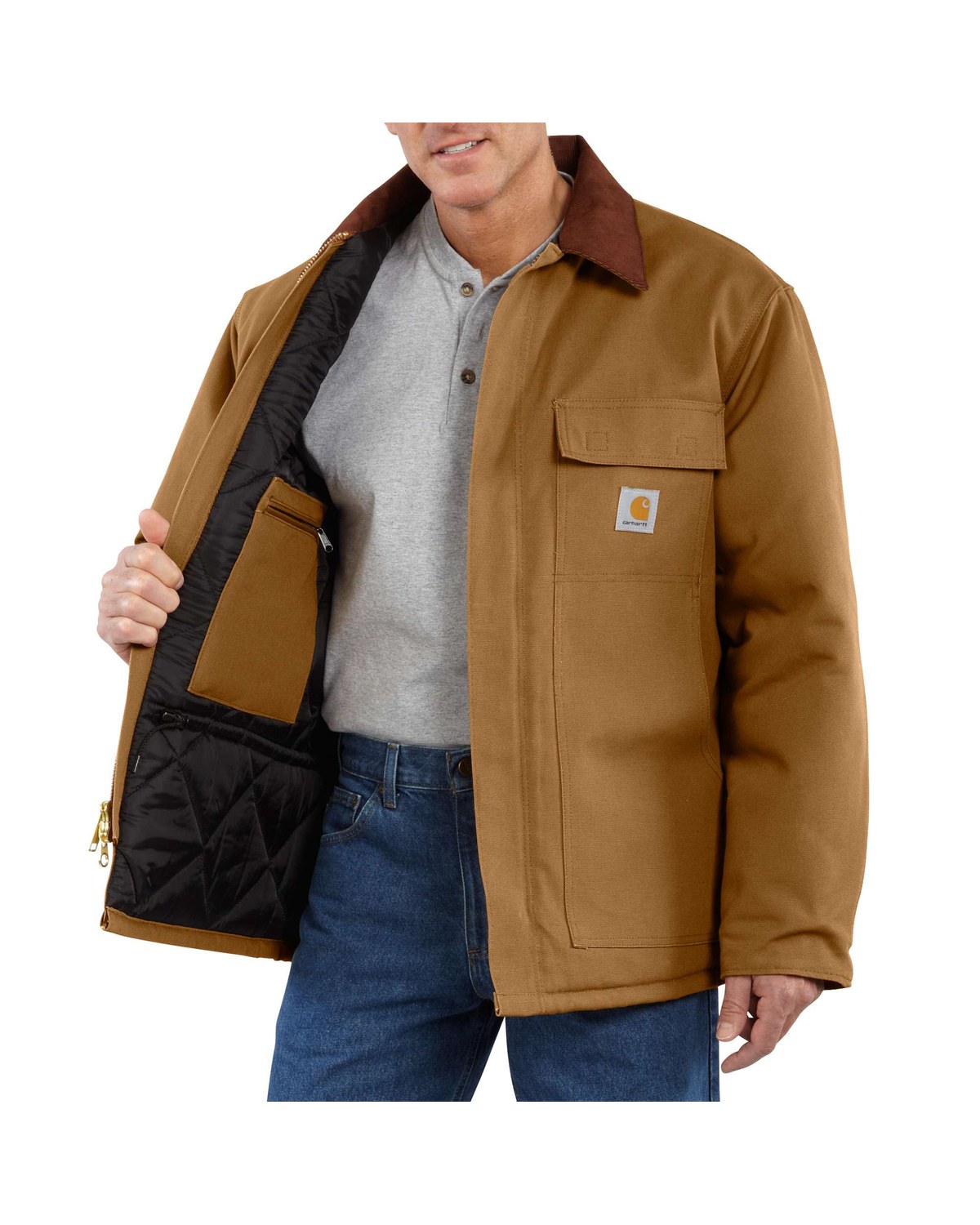
Carhartt rate their own outerwear one to three for warmth and this is a three, their warmest. Twelve ounce firm-hand duck over Arctic-weight insulation and a quilted lining, with a 30.75 inch back length that covers you properly when you sit down in a cold truck.
The corduroy collar and the two-way front zip are the only two things on it that aren't strictly functional, and the two-way zip is there so you can sit without the hem riding up. Nothing else here is this single-minded.
Storm cuffs sit inside the sleeve and seal against your wrist, which is warmer than a tab and much less adjustable. You can't open them up over a work glove, and you can't push the sleeves up. That's the trade for the warmth.
You work outside in real cold and you want one coat that ends the argument.
You want anything at all from the M-65 playbook. This scores lowest here.
The spec sheet
The spec sheet
Every line here comes from Carhartt. Where a line is missing from this rail, the brand doesn't publish it.
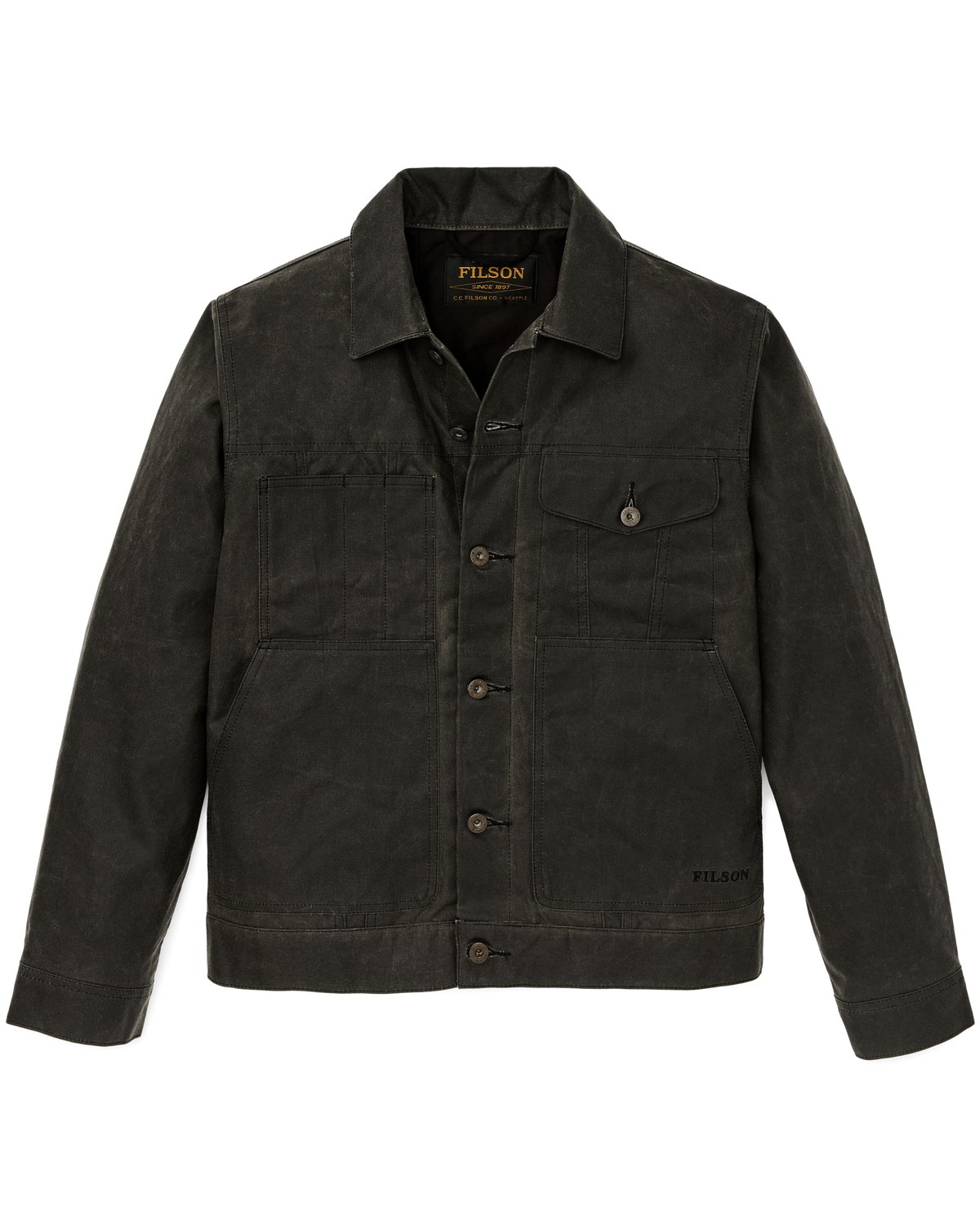
Fourteen ounces, and it will outlive you
Filson Tin Cloth Short Lined Cruiser Jacket
Filson's Tin Cloth is the heaviest cloth on this page by a distance, a fourteen ounce oil-finish waxed duck with a weave Filson describe as uncommonly tight. It's the closest thing in clothing to armor, and their own line about it is the honest one: Tin Cloth is built to break in rather than wear out.
The cut is hip length on purpose, so you can sit down and still reach your pockets or a tool belt. The left chest pocket is slotted for a carpenter's pencil, which tells you exactly who Filson still think is buying this.
New Tin Cloth is closer to a board than a jacket and takes a season of wearing before it moves with you. Everyone who owns one says the same thing, which is that it's worth it and that you should know before the box arrives.
You want a work jacket you'll hand down rather than replace.
You want something soft and easy from day one.
The spec sheet
The spec sheet
Every line here comes from Filson. Where a line is missing from this rail, the brand doesn't publish it.
Where the money goes, and where it doesn't
Five hundred dollars and up buys better cloth, better making and, on one of these, the most faithful M-65 pattern on the page. It also buys the thinnest spec sheets we read all week, which is worth knowing before you spend.
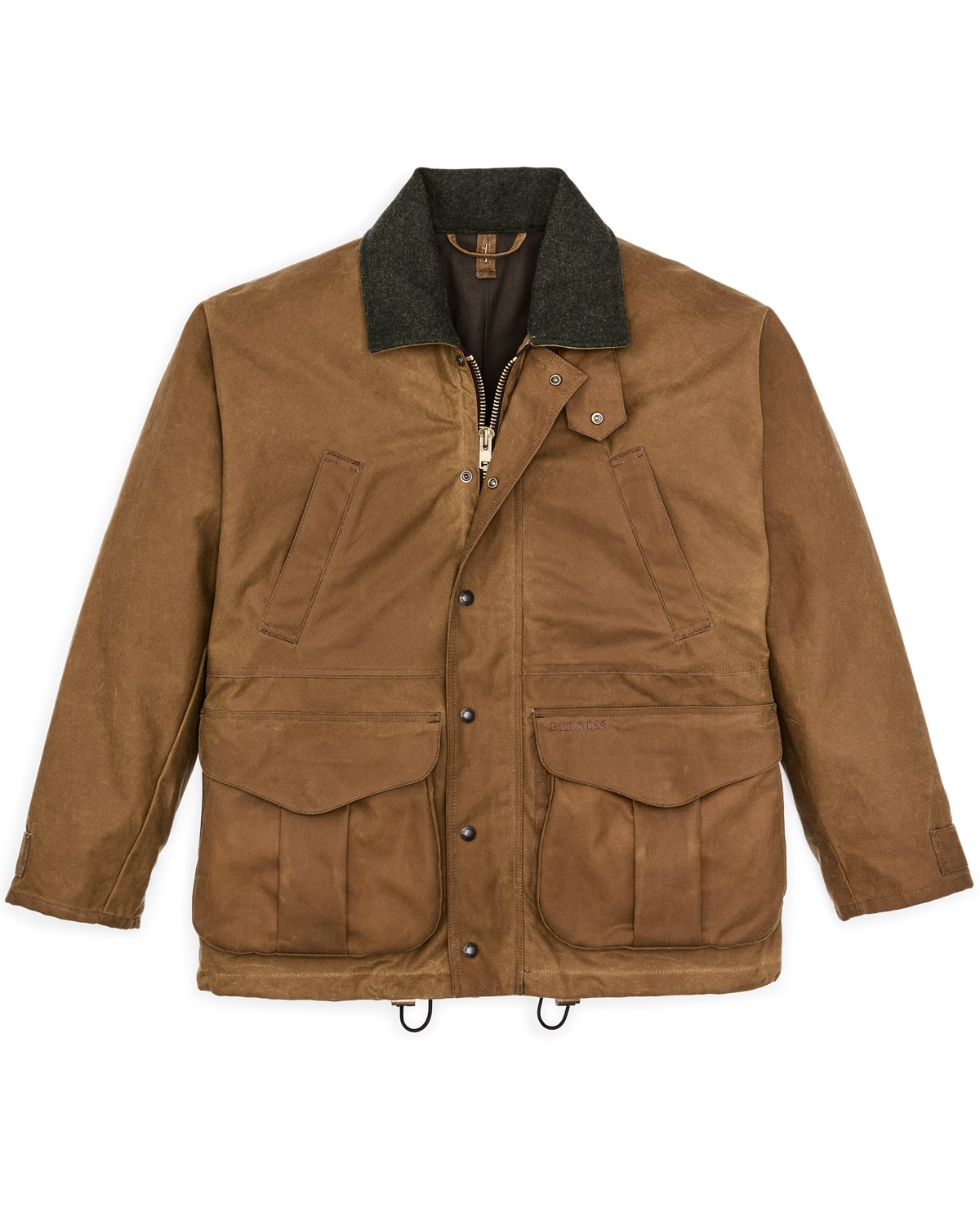
The only jacket here with the waist and the liner port
Filson Lined Tin Cloth Field Jacket
This is the closest anything gets to the M-65 without being a military copy. Drawcord adjustment at both the waist and the hem, four expandable front pockets, and select Filson liners fasten in on an interior zipper. Three of the six things on our checklist, which nothing else outside Alpha manages.
The rest is pure Filson. Caped shoulders to keep seams out of driving rain, dividers in the front pockets that were designed to separate live and spent shotgun shells, and Mackinaw wool lining the hand pockets and the collar.
The interior zipper is there and the liners exist, but none of them comes in the box. Price the jacket and the liner together before you compare this with the coats that arrive warm.
You want serious weather protection and the field jacket structure with it.
Five hundred dollars before you've bought the liner is more than this needs to be.
The spec sheet
The spec sheet
Every line here comes from Filson. Where a line is missing from this rail, the brand doesn't publish it.
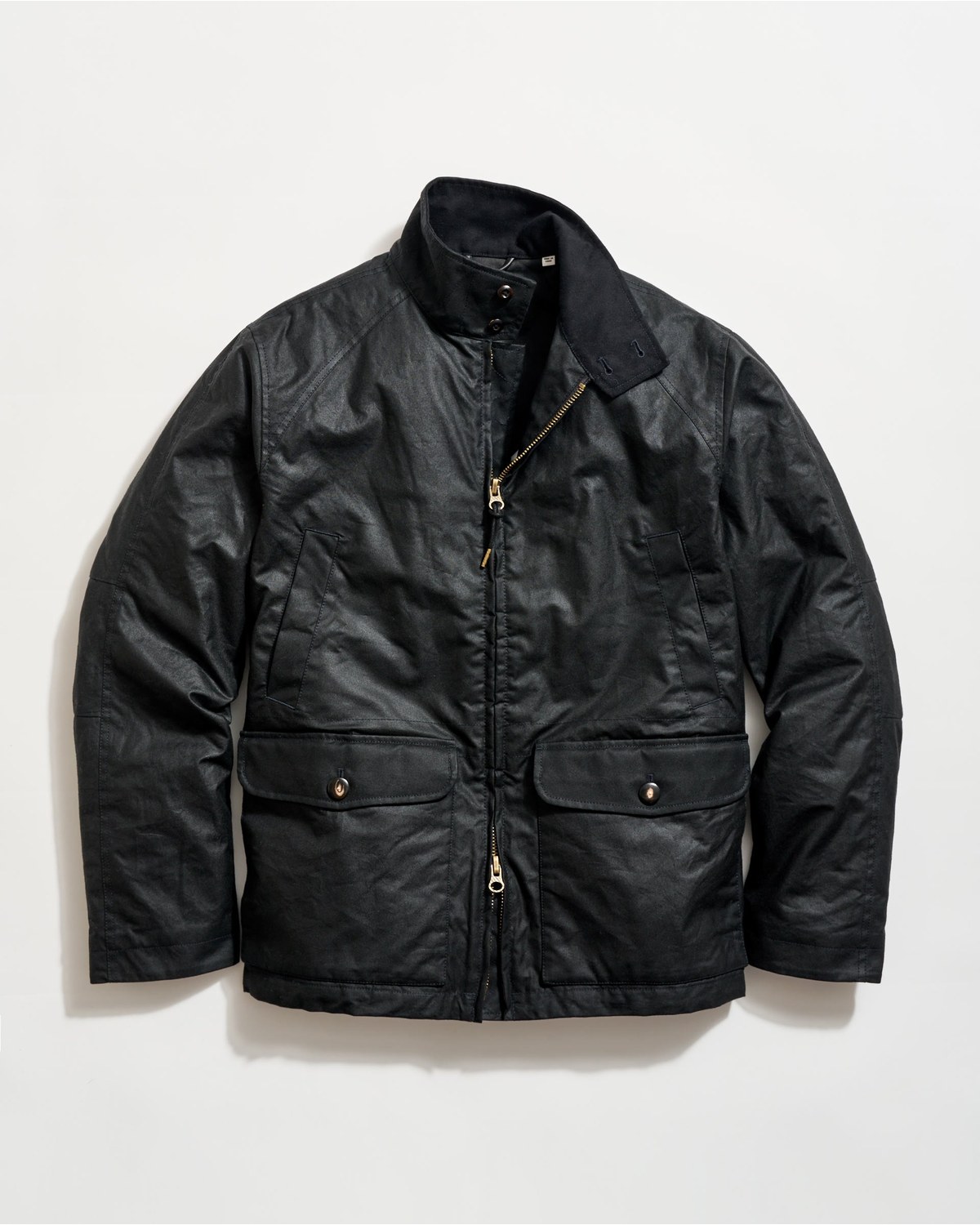
The best-looking thing on the page, and the thinnest spec sheet
Billy Reid Hunting Jacket
Billy Reid have been making American clothes in Florence, Alabama for twenty years and this is an archive piece brought back for the anniversary. Waxed cotton outside, moleskin at the inner collar and under the pocket flaps, an onion cloth liner for insulation, and a standard fit cut to go over a sweater.
In black waxed cotton it's the one jacket here that works over tailoring, which is a narrow but real thing that none of the others do.
Our scale counts details the brand states, and Billy Reid's page states the fabric, the moleskin, the liner and the fit. No pocket count, no waist adjustment, no cuff detail. The score reflects the product page rather than a judgment on the jacket, and this is the single clearest example on the page of the expensive tier telling you the least.
You want a beautiful waxed jacket that reads dressier than the rest of this page.
You want to know what you're buying before it arrives.
The spec sheet
The spec sheet
Every line here comes from Billy Reid. Where a line is missing from this rail, the brand doesn't publish it.
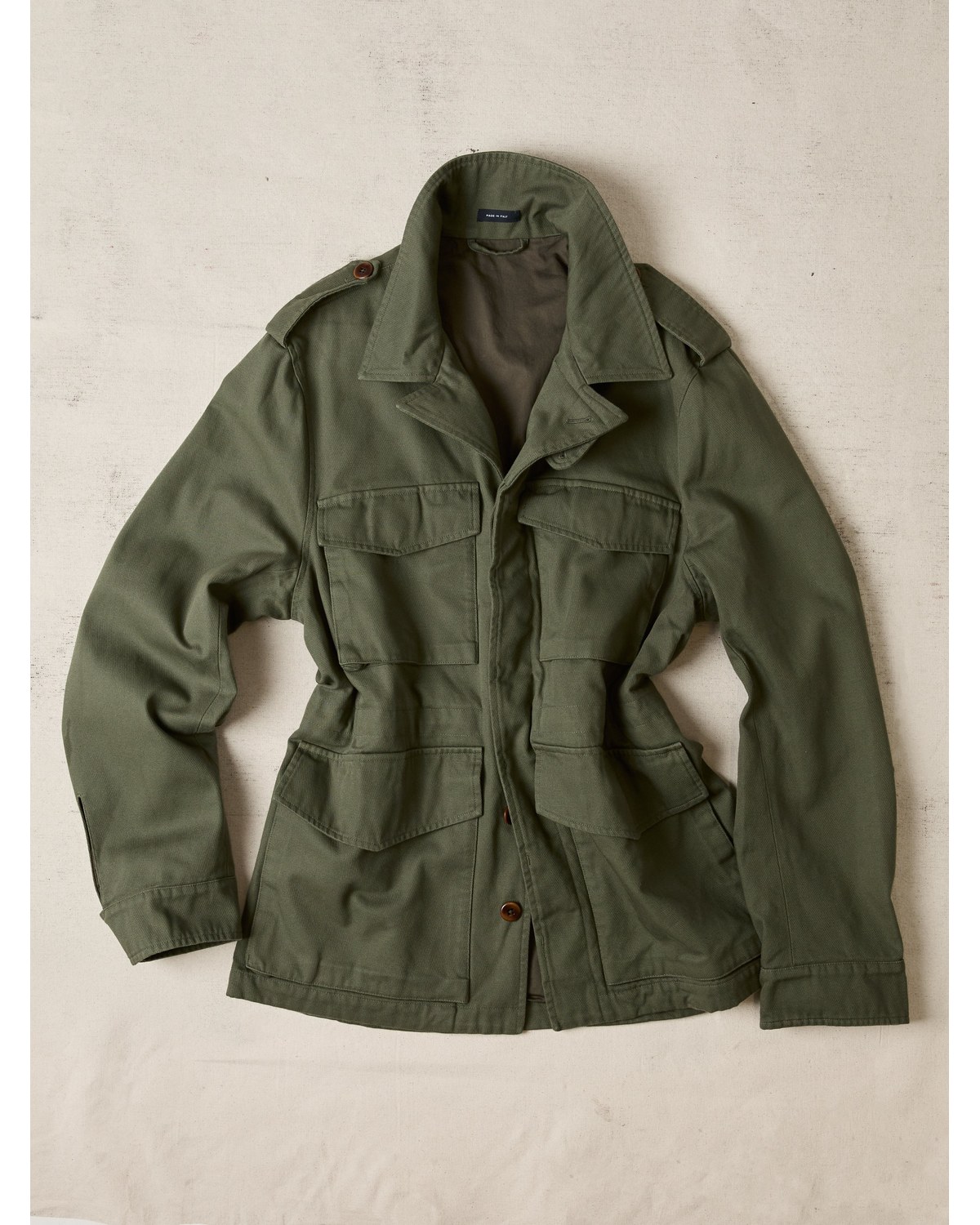
The M-43, which is what the M-65 was replacing
Drake's Olive Cotton D-43 Field Jacket
The M-43 is the M-65's predecessor, and Drake's have reproduced the blueprint rather than referenced it. Four patch-and-flap gusset pockets, corozo buttons, a throat latch, and an internal drawstring waist with leather pig-nose stoppers, all published by name on their own page.
The cloth is the reason for the price. Sixteen and a half ounces, woven in Japan, reproduced from an obscure Bulgarian military fabric. It's the heaviest unwaxed cotton here and it hangs like nothing else on this list.
It runs 36 to 44 like a jacket rather than S to XL like outerwear, which is a better system and an unfamiliar one. Measure the chest of a jacket you already own and match that number rather than guessing from your shirt size.
You want the most faithful mid-century field jacket money can currently buy.
Thirteen hundred dollars is thirteen hundred dollars.
The spec sheet
The spec sheet
Every line here comes from Drake's. Where a line is missing from this rail, the brand doesn't publish it.
The receipts
Who publishes what
Three of the six details, and exactly how many of the twelve are willing to print each one on their own product page.
Four pockets on the front11 of 12
The one thing almost everything gets right. Count them in the product photo. Two chest pockets and two lower pockets is the real thing. Two lower pockets and a chest zip is a jacket wearing the look.
A waist you can pull in5 of 12
The detail that decides how the jacket sits. Look for the words drawcord, drawstring or adjustable at the waist. A snap tab at the hem is a related idea, but it pulls in the bottom edge and not the middle.
A hood hidden in the collar2 of 12
The party trick almost nobody bothers with. Zip across the back of the collar, or a stand collar that's suspiciously thick. Brands that have it almost always mention it, because it's expensive to build.
Side by side
All twelve, in one table
Every column is either a brand figure or our one scale. There's nothing scored, weighted or averaged.
| Jacket ▲▼ | Price ▲▼ | Tier ▲▼ | Fabric ▲▼ | Waist ▲▼ | Against the M-65 ▲▼ |
|---|---|---|---|---|---|
| Wolverine Lockhart Jacket | $99.95 | Inexpensive | Cotton duck canvas | Fixed | 45 of 100 |
| Abercrombie & Fitch Military Jacket | $160 | Inexpensive | Cotton twill, washed | Fixed | 45 of 100 |
| L.L.Bean Original Field Coat | $180 | Inexpensive | 10 oz cotton canvas with corduroy trim | Fixed | 25 of 100 |
| Alpha Industries M-65 Field Jacket | $250 | Heritage | Cotton and nylon sateen, water and wind resistant | Adjustable | 100 of 100 |
| Alpha Industries M-65 Mod Field Jacket Gen II | $225 | Heritage | Cotton, garment washed | Adjustable | 55 of 100 |
| L.L.Bean 1924 Field Coat | $250 | Heritage | British Millerain wax cotton with a chamois lining | Fixed | 35 of 100 |
| Carhartt Rugged Flex Duck Berwick Jacket | $109.99 | Workwear | 12 oz duck, 99% cotton and 1% spandex | Adjustable | 35 of 100 |
| Carhartt Firm Duck Insulated Traditional Coat | $139.99 | Workwear | 12 oz firm-hand 100% ringspun cotton duck | Fixed | 25 of 100 |
| Filson Tin Cloth Short Lined Cruiser Jacket | $359 | Workwear | 14 oz oil-finish Tin Cloth waxed cotton duck | Adjustable | 45 of 100 |
| Filson Lined Tin Cloth Field Jacket | $499 | Luxury | 14 oz oil-finish Tin Cloth over a Mackinaw wool and cotton lining | Adjustable | 60 of 100 |
| Billy Reid Hunting Jacket | $698 | Luxury | Waxed cotton with moleskin at the collar and pocket flaps | Fixed | 15 of 100 |
| Drake's Olive Cotton D-43 Field Jacket | $1,295 | Luxury | 16.5 oz Japanese cotton, reproduced from a Bulgarian military cloth | Adjustable | 65 of 100 |
Tap any column heading to sort. The last column is our scale, not a brand figure, and it counts only what the brand publishes.
Before you buy
Four things worth checking in the next five minutes
- Count the pockets in the photo. Two on the chest and two at the hip is the real shape. Two at the hip and a zip on the chest is a jacket doing an impression.
- Look for the word drawcord. If the waist is fixed, the fit you see on the model is the fit you get, and these patterns are cut roomy on purpose.
- Check whether the liner comes out. Fully lined and removable liner aren't the same thing, and only one of them gives you two jackets.
- Read the fabric weight. Anything at 12 oz or more is a work jacket and will feel like one on a train. Under 12 oz is the comfortable everyday range.
Questions
The ones we get asked
What actually counts as a field jacket?
A hip or thigh length cotton jacket with four pockets on the front, descending from military field clothing. The M-65 is the pattern most people picture: four pockets, a drawcord waist, a hood zipped into the collar, epaulettes, cuff tabs and a liner that buttons in. Almost nothing sold as a field jacket has all six, which is exactly why we scored them.
Is the Alpha Industries one really the original?
Alpha were a contractor to the US military for the M-65 and they still make it to military specification, which their own product page states. That's why it sits at the top of our scale rather than just appearing as another pick. Whether it's the right jacket for you is a different question, and the answer depends mostly on whether you want an oversized 1965 cut.
Waxed cotton or plain canvas?
Waxed sheds rain, blocks wind and ages beautifully, and in exchange it doesn't breathe, it marks light upholstery for the first season, and it needs re-waxing every year or two. Plain canvas asks nothing of you and gets a lot less wet. If the jacket is mostly going to live in a city, canvas is the easier ownership experience by a wide margin.
How much should I actually spend?
If you want the look and normal use, the honest answer from this page is somewhere between $100 and $180, because that range covers cotton canvas, four pockets and, in one case, the stowaway hood. Spending more buys heavier cloth, better making, and either the removable liner or a genuinely faithful military pattern. It doesn't buy a better silhouette.
What size should I get?
Field jackets were cut to go over a uniform, so most of them run roomy by design and the Alpha M-65 says so on its own page. If you want it to look like the photographs, buy your normal size and accept the volume. If you want it trim, you're fighting the pattern, and you'd be better off with one of the modern cuts here that was drafted that way.
Does a jacket with a low score mean it's worse?
No, and that's the most important thing to say about the scale. It counts how closely a jacket follows one specific 1965 military pattern. A Carhartt work coat scores low because it's built for a different job and does that job better than any M-65 would. The score tells you what you're getting, not what's good.
How we did this
Our method, in full
Only what the brand prints
Each of the six details is counted only when the brand states it on its own product page. If a jacket has a feature and doesn't mention it, we don't count it, and we say so on the card. That's the fairest rule we could find and it's occasionally hard on a good jacket.
Stock checked at the size level
Every price and every availability line was read off the page we link, at the size level wherever the store exposes one. Nothing on this page is on markdown.
Tiers are kinds, not prices
We don't rate jackets out of ten. The four tiers describe what a jacket is for, and the single scale describes how closely it follows the M-65. Neither one is a quality grade.
