 Skip to content
Start here
There's a rule in the US that makes a brand tell you when a jacket isn't leather. There's no rule making them tell you which animal it is, or which layer of the hide it came from. That asymmetry is the whole reason this page exists.
We graded all seventeen on exactly that. 12 of the 14 real-suede jackets clear the first bar. Only 3 clear both. One brand sells two suede jackets this same season and names the hide on one of them and not the other, which tells you how little of this is standardized and how much of it comes down to whether anyone bothered.
None of this makes the vague ones bad jackets. It just means that on those, the one specification that predicts how the thing will wear is missing, and you're buying the brand instead. Here's how to read what is there.
Where this guide landed
Tool one
What the label actually tells you
Every jacket here, graded on how much the brand actually committed to. Tap any one to jump straight to our full verdict on it.
Two questions, and most brands answer one
Which animal, and which layer of the hide. Answer both and a reader knows how the jacket will wear. Answer neither and the word suede is doing all the work.
Names the animal and the layer3 of 17
Both halves of the question, in writing. Nothing required them to do this.
Names the animal only9 of 17
You know which hide, not which layer. Most suede is the split, so that’s the way to bet.
Says only “suede”2 of 17
Still real suede. But the one specification that predicts how it wears isn’t printed.
Not leather, and says so3 of 17
This is the disclosure the FTC leather guides actually require, and every one of these makes it.
Tool two
Which hide, and why it matters
The animal changes how a jacket drapes, how long it lasts and what it costs. Pick one to see what it does and which jackets use it.
Goatskin
The sweet spot for a jacket
Goat fiber bundles interweave tightly, and a study of Brazilian goatskins found tear strength close to doubling as the animal matured. It's thin, it drapes, and it takes daily wear better than lamb. It's also the most common hide in this guide.
Tool three
The disclosure ladder
All seventeen ranked by how complete the label is, not by how good the jacket is. A jacket can sit low here and still be worth buying. It just means you're buying on trust.
The shortlist
Seventeen suede jackets, grouped by cut
Prices checked in October 2026. Suede stock moves fast and several of these are the last of a run, so check before you commit.
Suede truckers
Cut like a jean jacket: chest flap pockets, a snap or button placket, waist adjusters. It's the shape most people picture, and it's the group with the cleanest run of prices.
The cheapest real trucker here
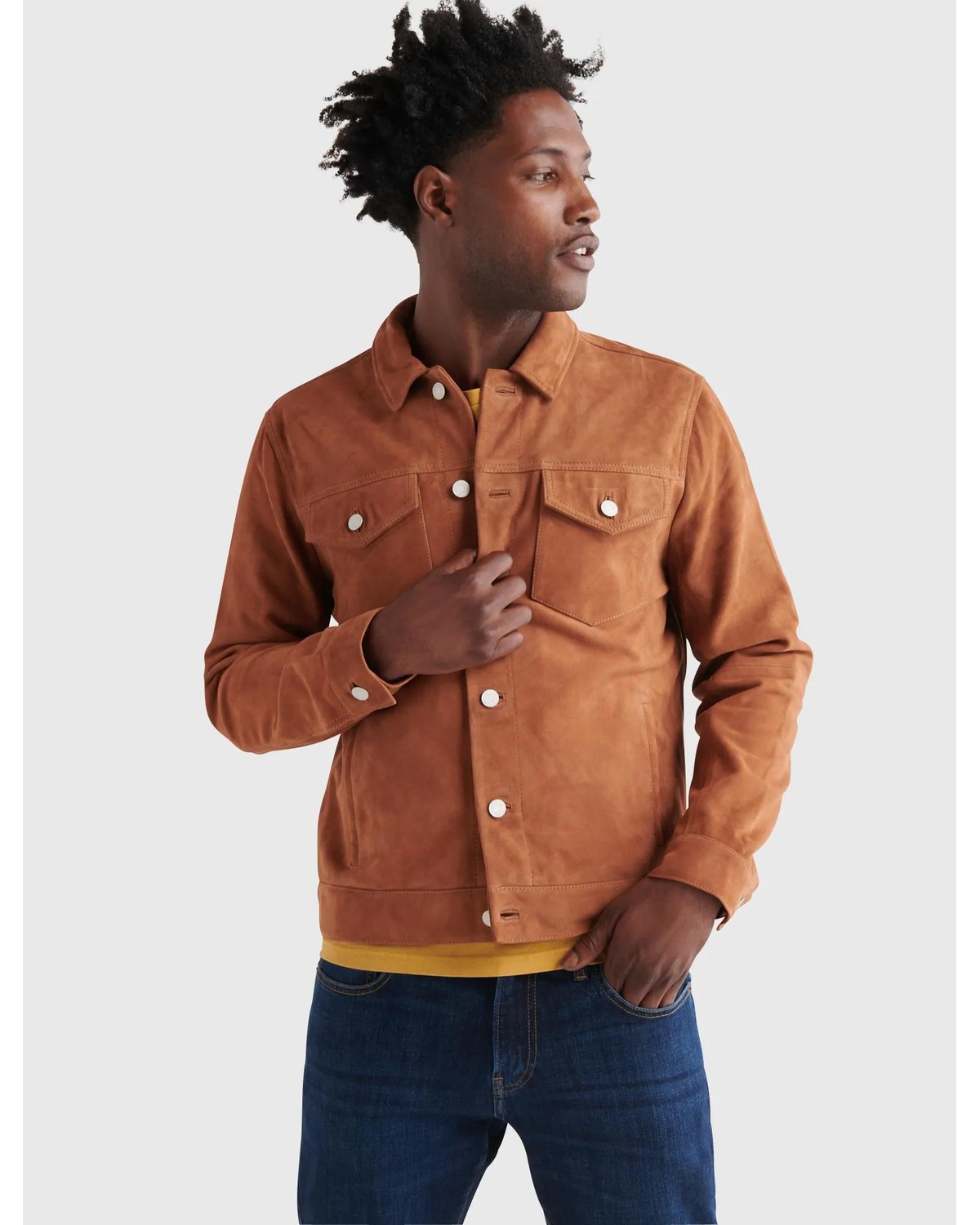
Lucky Brand Suede Trucker Jacket
Goat suede, named on the tag, in a proper trucker cut with the chest flaps and the waist adjusters, for the price a lot of brands charge for polyester. That combination isn't supposed to exist at $149.99, and it's the reason this jacket opens the guide.
The catch is that Lucky's pricing moves constantly. It's been at three different numbers in the time we've been checking, and Dark Chestnut is already thin on sizes. If the price you see is close to this one, that's the real price.
This one swings with flash promos more than anything else on the page. It's worth loading the listing twice a few days apart before you decide, because the gap between a good week and a bad week here is real money.
You want the classic shape, in brown, in real suede, and you don't want to spend three figures more to get it.
You need a specific size in Dark Chestnut. Stock is already patchy and it isn't coming back at this price.
The Label
The Label
Says the quiet part out loud
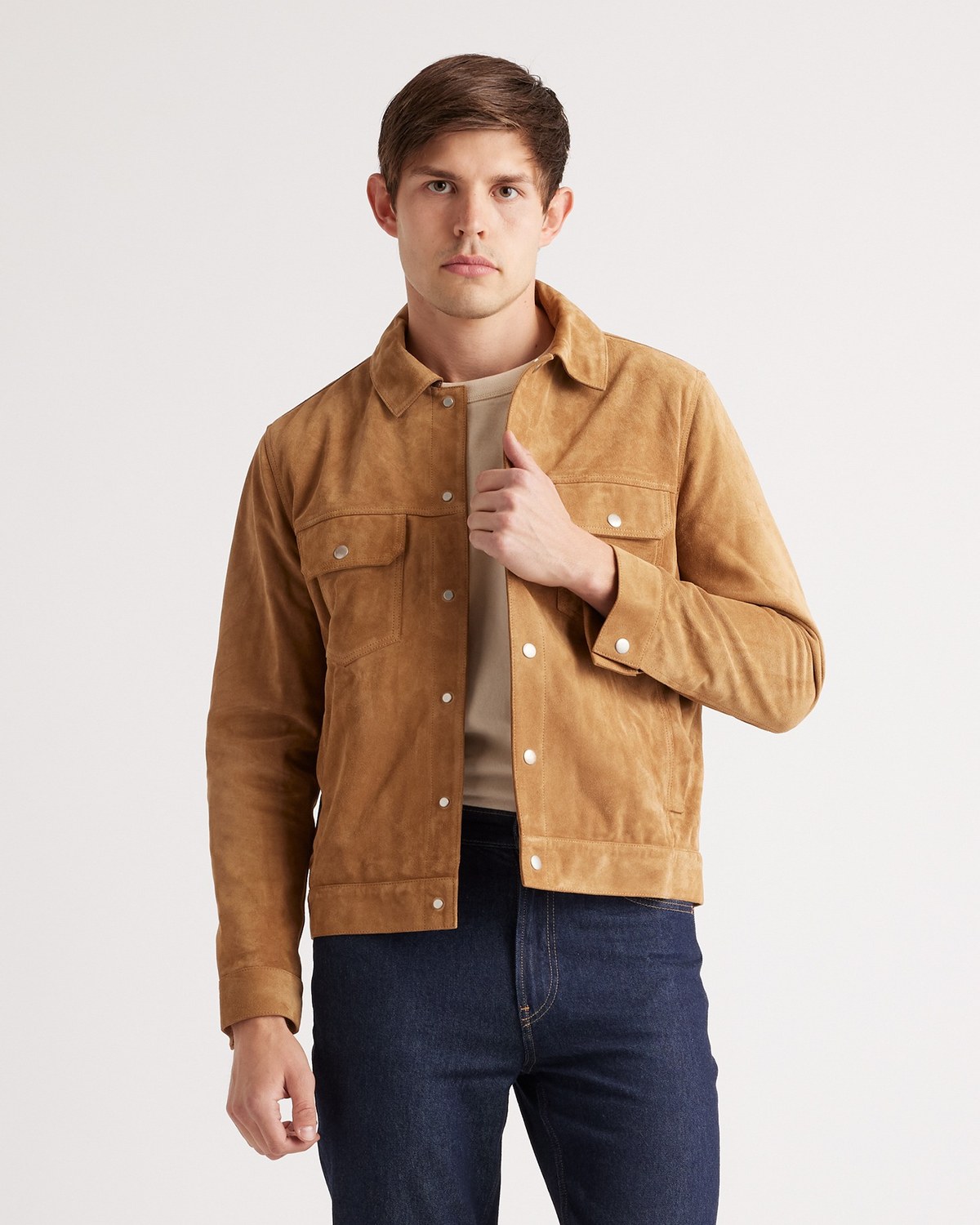
Quince Italian Suede Trucker Jacket
Read that composition line again, because almost nobody writes it this way. Quince tells you the animal and tells you it's the split, the underside layer left after the grain is taken off. Most suede is exactly that. Most brands just don't say so.
Cow split is the tougher, thicker end of the suede range, so this wears more like outerwear than like a soft second skin. In four colors including two proper browns, at $300, it's the most jacket per dollar on this page.
A hide gets sliced into layers. The outside is the grain, everything underneath is the split. Suede is made by buffing a nap onto the split, so calling it split suede is just describing what suede is. The brands leaving that word out aren't selling you something better.
You want one suede jacket that'll take actual wear, and you'd rather a brand told you what's in it than flattered you.
You want that liquid, drapey softness. Cow split is the stiffest hide in this guide and it takes a season to loosen up.
The Label
The Label
Built like a jean jacket, in goat
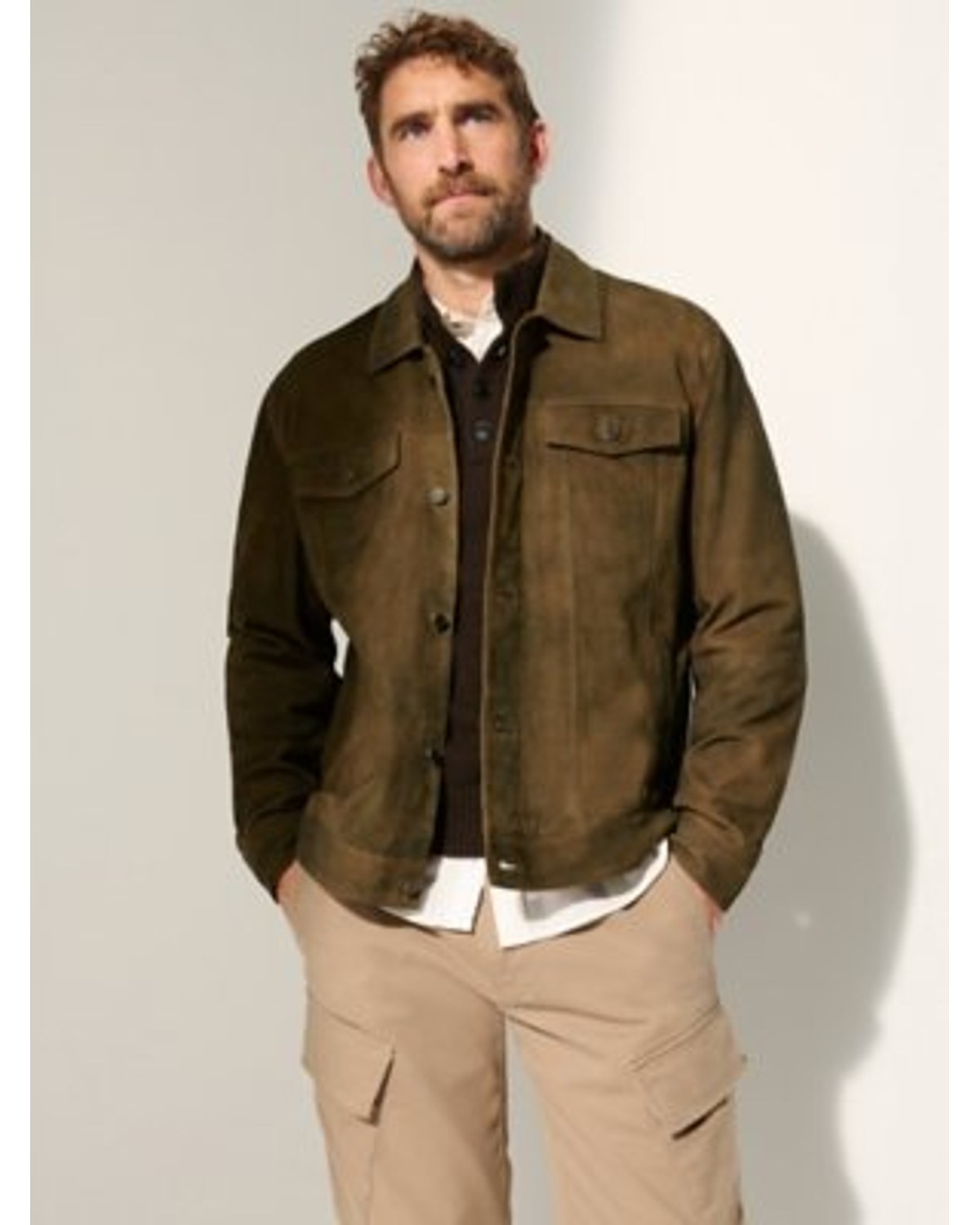
Overland Jimmy Suede Leather Jacket
Overland has been selling nothing but hides since the seventies, and it shows in how they describe things. The Jimmy is their trucker: goat suede, named, with what they call a jungle finish, which is a deliberate tonal mottling rather than one flat color.
That finish is the whole argument for this jacket over a cheaper one. Flat-dyed suede looks its best in the photo and slowly gets worse. A mottled finish is already doing what good suede does after five years, so wear marks read as character instead of damage.
It isn't a single brown. There's more variation across a panel than a studio shot shows, which is the point of the finish, and it's also why this one photographs differently under a shop light than it will on you.
You want the trucker shape from a specialist, and you like suede that already looks lived in.
You want an even, uniform color. This isn't that, on purpose.
The Label
The Label
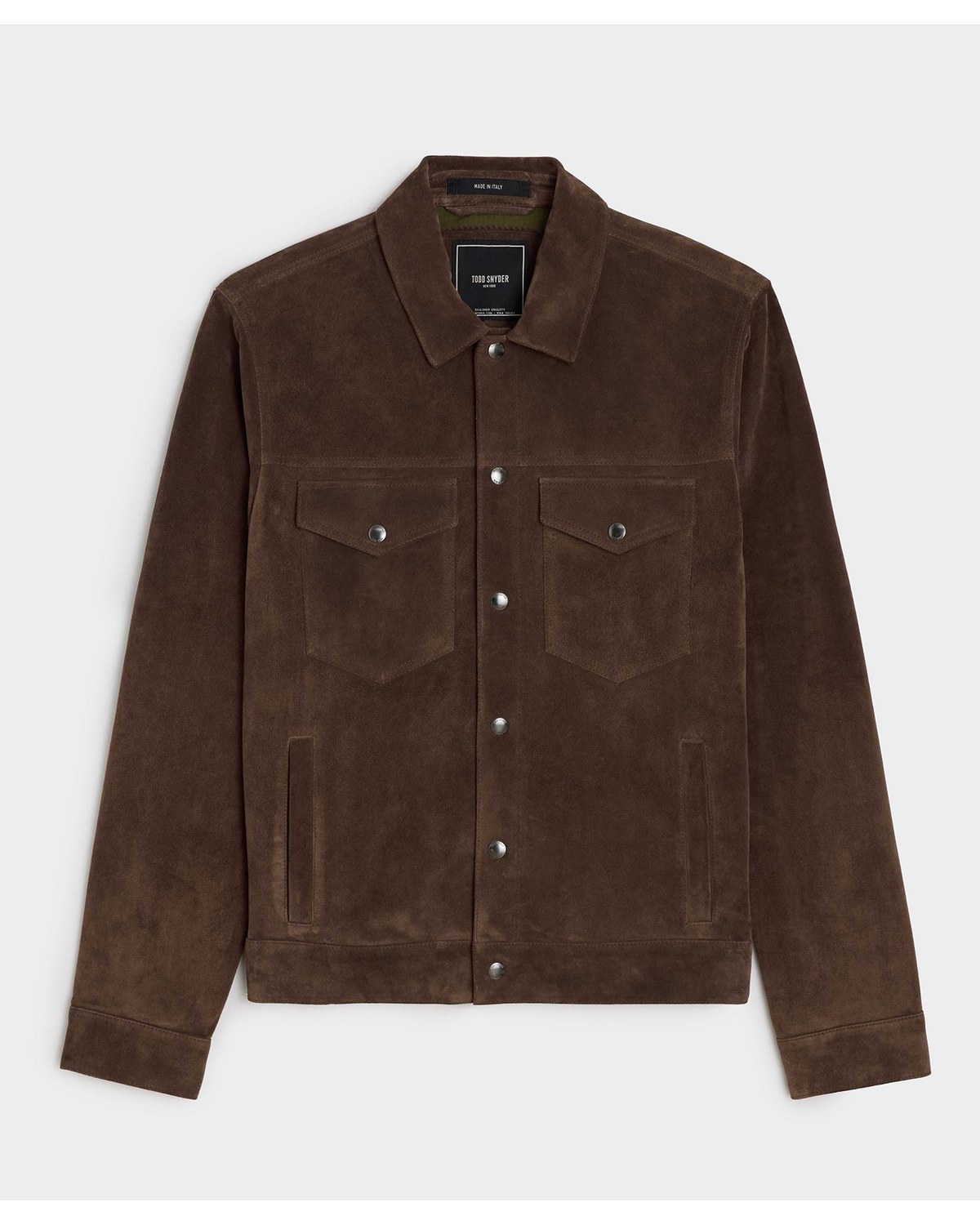
Names the animal and the tannery
Todd Snyder Italian Suede Dylan Jacket
Two things on this product page that almost never appear together: the hide is specified as calf, and the maker is named as Pellemoda in Italy. Naming the tannery is a reasonable proxy for being willing to stand behind the thing.
Calf is the fine-grained end of the range. Tightly packed fibers, a smoother and more even nap than goat or lamb, and enough body that the jacket holds its shape instead of collapsing on the hanger. Three browns, which is more than most of this list manages between them.
Those tight fiber bundles that make calfskin strong also make it drape less loosely than lamb. On a trucker that reads as structure, which is what you want. On something slouchy it would read as stiff.
This is the one you'll wear for a decade and you want the version with the fewest unanswered questions on the label.
You're not ready for four figures. The Quince trucker covers the same shape for less than a third.
The Label
The Label
Suede bombers
Knit collar, knit cuffs, zip front. Shorter and rounder than a trucker, and the only group here with two real-suede jackets under $210.
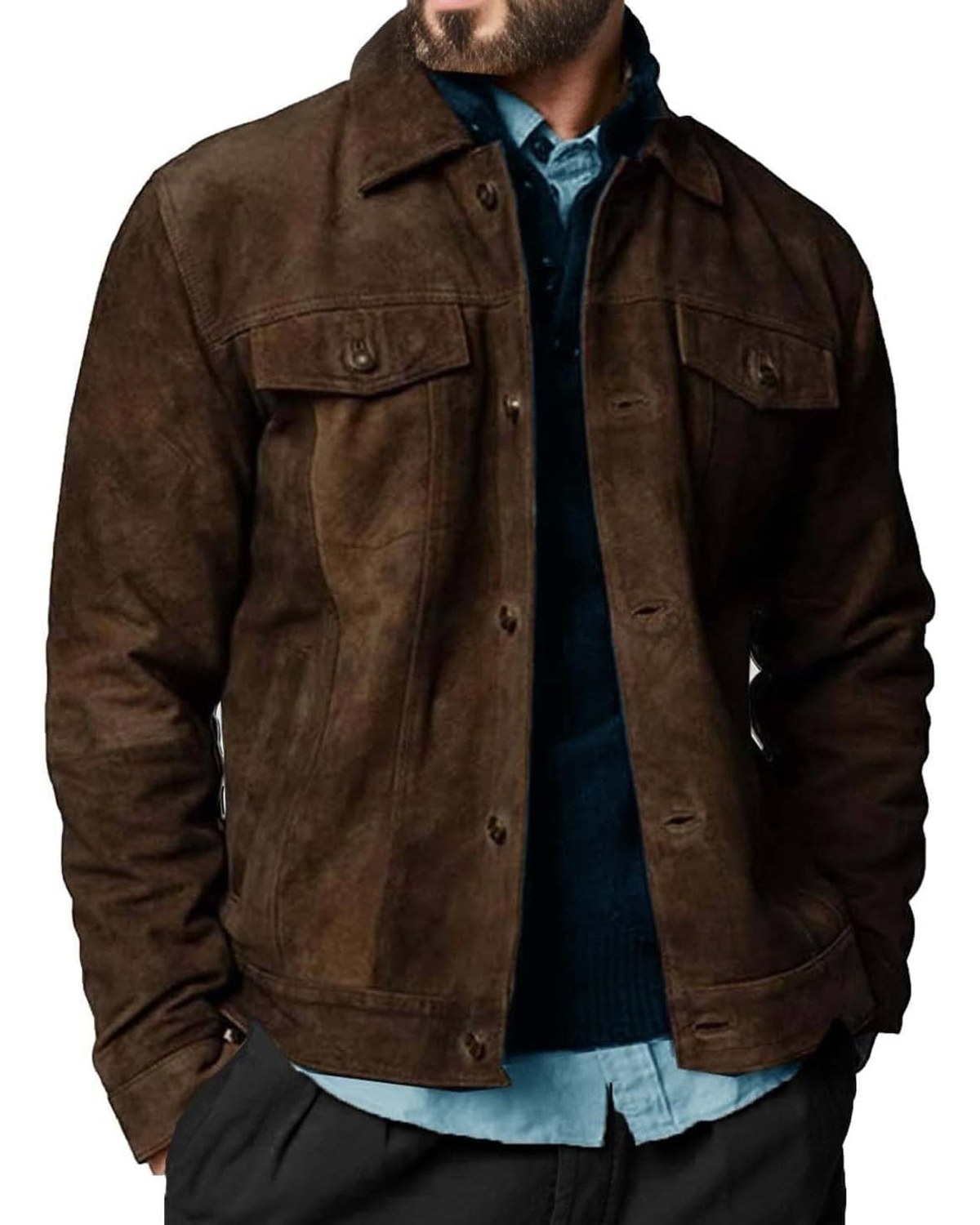
Real lambskin, under $200
Desired Jackets Real Lambskin Suede Jacket
Lambskin at this price usually means something else is wrong, so the composition line is doing a lot of work here: it says real lambskin, plainly. Five colors including a dark brown, and it's the softest hide in this guide by a distance.
Set your expectations with the material, not the price. Lambskin is soft because the layers inside it don't bond tightly, and that same looseness is why it's the hide most likely to thin at the elbows and stretch at the cuffs. This is a jacket to enjoy, not to hand down.
Wool follicles and fat sit between lambskin's outer layer and the fiber mass underneath, so the two never grip each other properly. That's what you're feeling when it drapes like fabric, and it's also what gives out first.
You want to know what good suede feels like without spending four figures to find out.
This is your only jacket and it's going to get worn hard five days a week. Buy goat or cow instead.
The Label
The Label
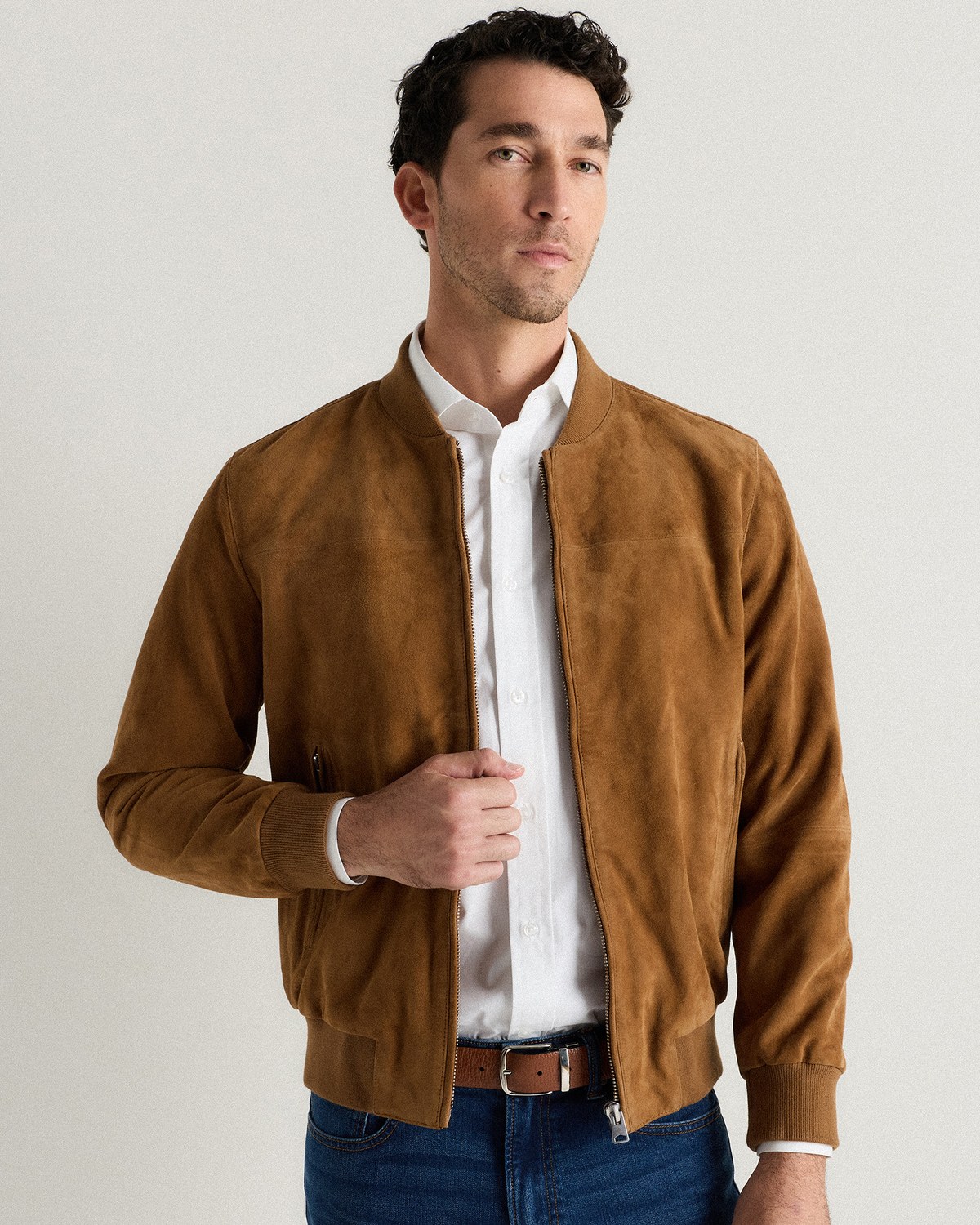
Top grain, and it says so
Quince 100% Suede Bomber Jacket
This is the only jacket in the guide whose label claims the grain side rather than the split, and pairs it with the best all-round hide for a jacket. Top grain goat, in cognac, for $200. On the numbers alone it's the best-value jacket on this page.
Goat is where most people should land. It's thin enough to drape, tightly woven enough to take daily wear, and it doesn't need the break-in period cow does. A knit collar and cuffs keep it closer to a classic bomber than the boxier cuts around it.
The grain is the outside of the hide where the fibers are densest, the split is everything underneath. Suede is normally made from the split, so a brand claiming top grain is claiming the stronger layer.
You want the single best combination of hide, price and honesty in this guide.
You want a long or roomy jacket. This is a true short bomber and it sits at the waist.
The Label
The Label
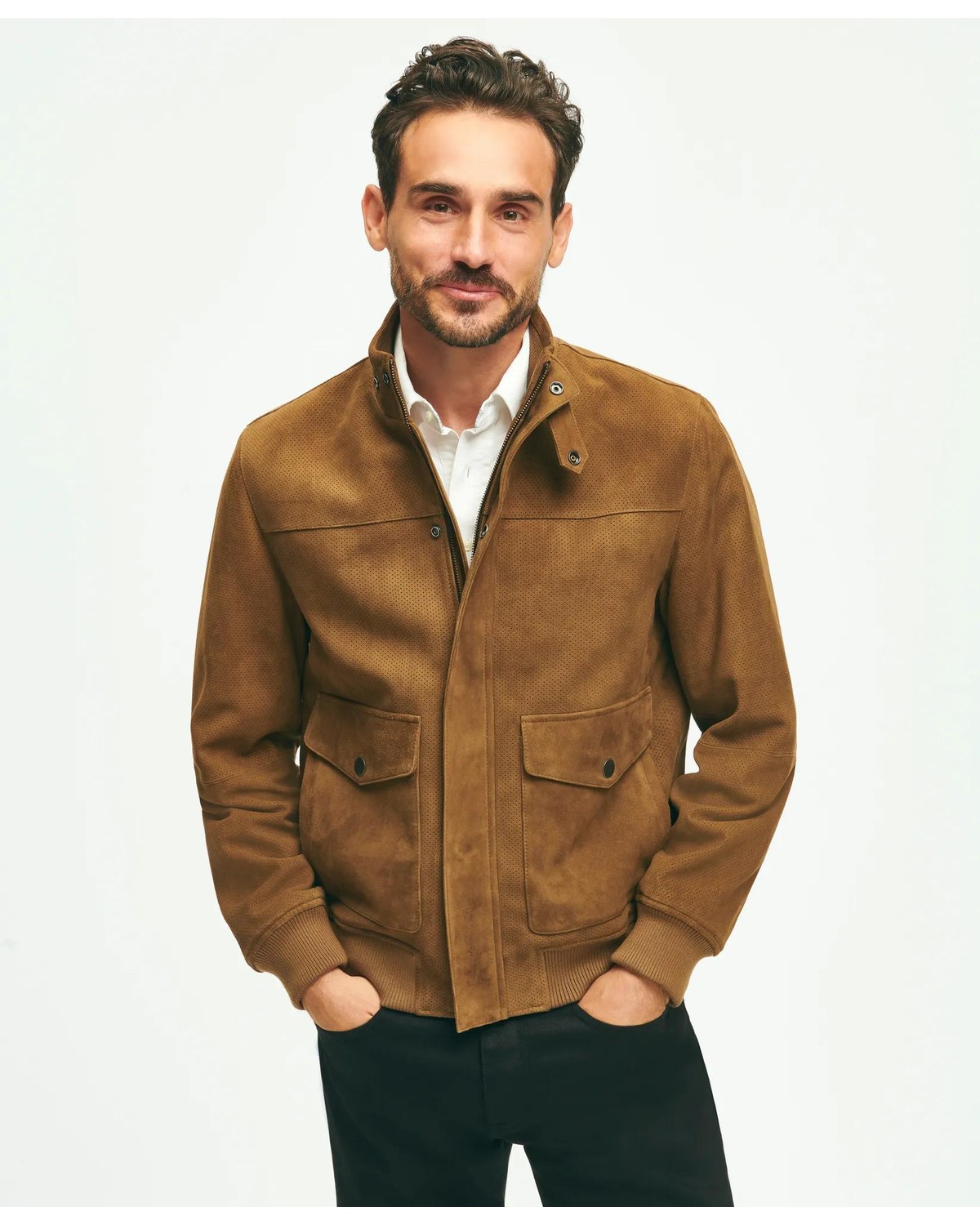
The only Brooks suede that names the hide
Brooks Brothers Perforated Suede Bomber Jacket
Brooks Brothers sells four suede jackets right now and three of them say nothing more than 100% Suede. This one says goat. Same store, same season, and the difference is purely whether somebody filled in the field.
It's a lighter jacket than the rest of this group because of the perforation, which makes it the one that works in September rather than only in November. Half off, in brown, and lined in twill rather than left raw.
Those holes are there for airflow, and they'll let water through to the lining faster than solid suede would. It's a dry-day jacket, which is fine as long as you know that going in.
You want goat suede from a name you recognize and you'd rather wear it in mild weather than deep winter.
You want one jacket for the whole season. The perforation cuts both ways.
The Label
The Label
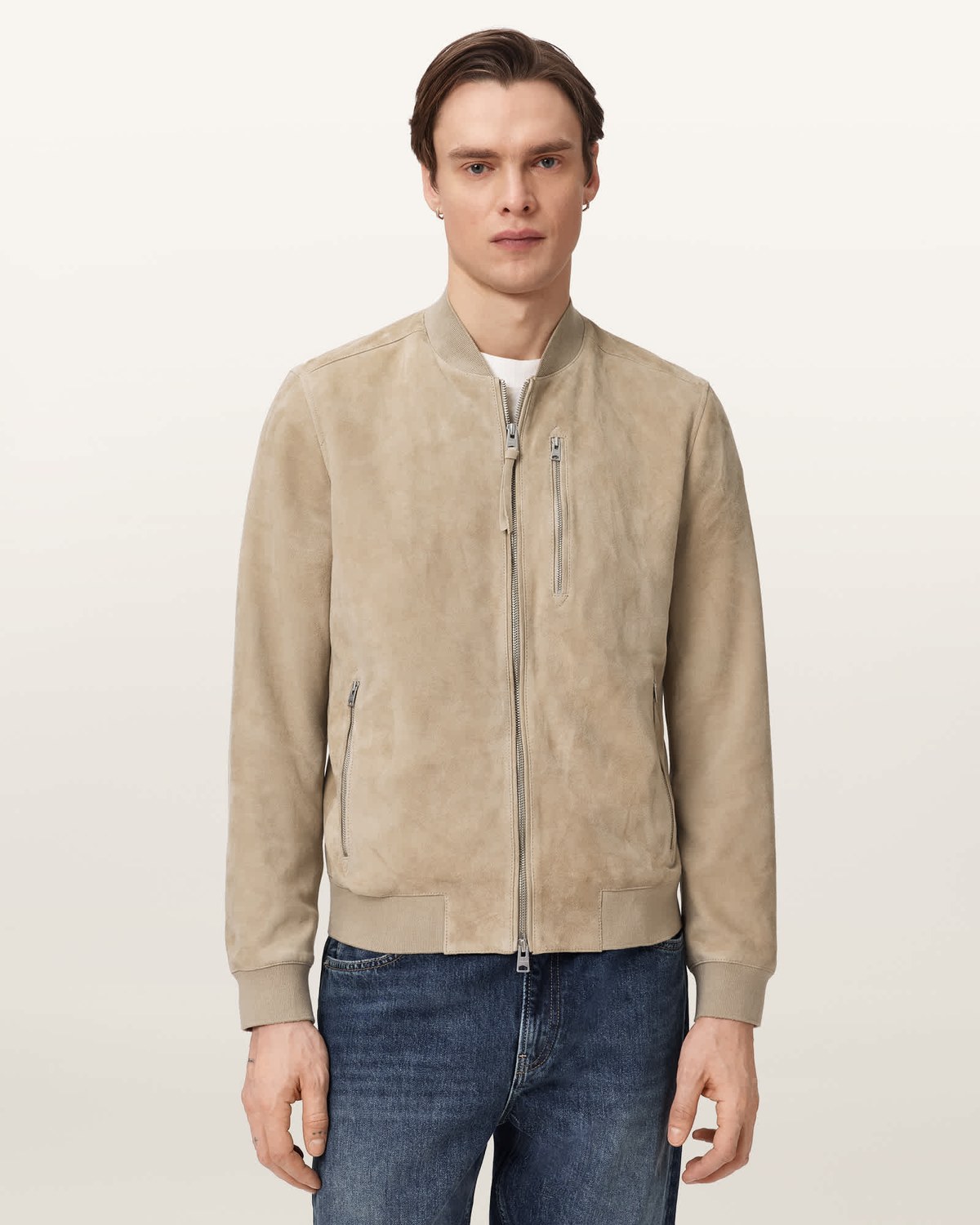
Every component, spelled out
AllSaints Kemble Suede Bomber Jacket
Nobody else on this page breaks a jacket down this far. Shell, body lining, sleeve lining and rib are each given their own line with their own percentages. Whether or not you care about modal, a brand that itemizes to that level is telling you something about how it thinks.
AllSaints has built a lot of its reputation on suede outerwear, and the Kemble is the most wearable thing in their current run: goat, one clean brown, and a cut that isn't trying to be a moto jacket.
Slippery sleeve linings exist so the jacket goes on over a sweater without fighting you. Pairing a soft modal body with a slick polyester sleeve is a deliberate choice, not a cost cut, and you notice it every time you put it on.
You want a brown goat suede bomber and you like knowing exactly what you're getting.
You want options. There's one color and that's it.
The Label
The Label
Suede overshirts
Shirt cut, worn open over a tee or under a coat. This is the hardest one to buy right now, and the section is honest about why.
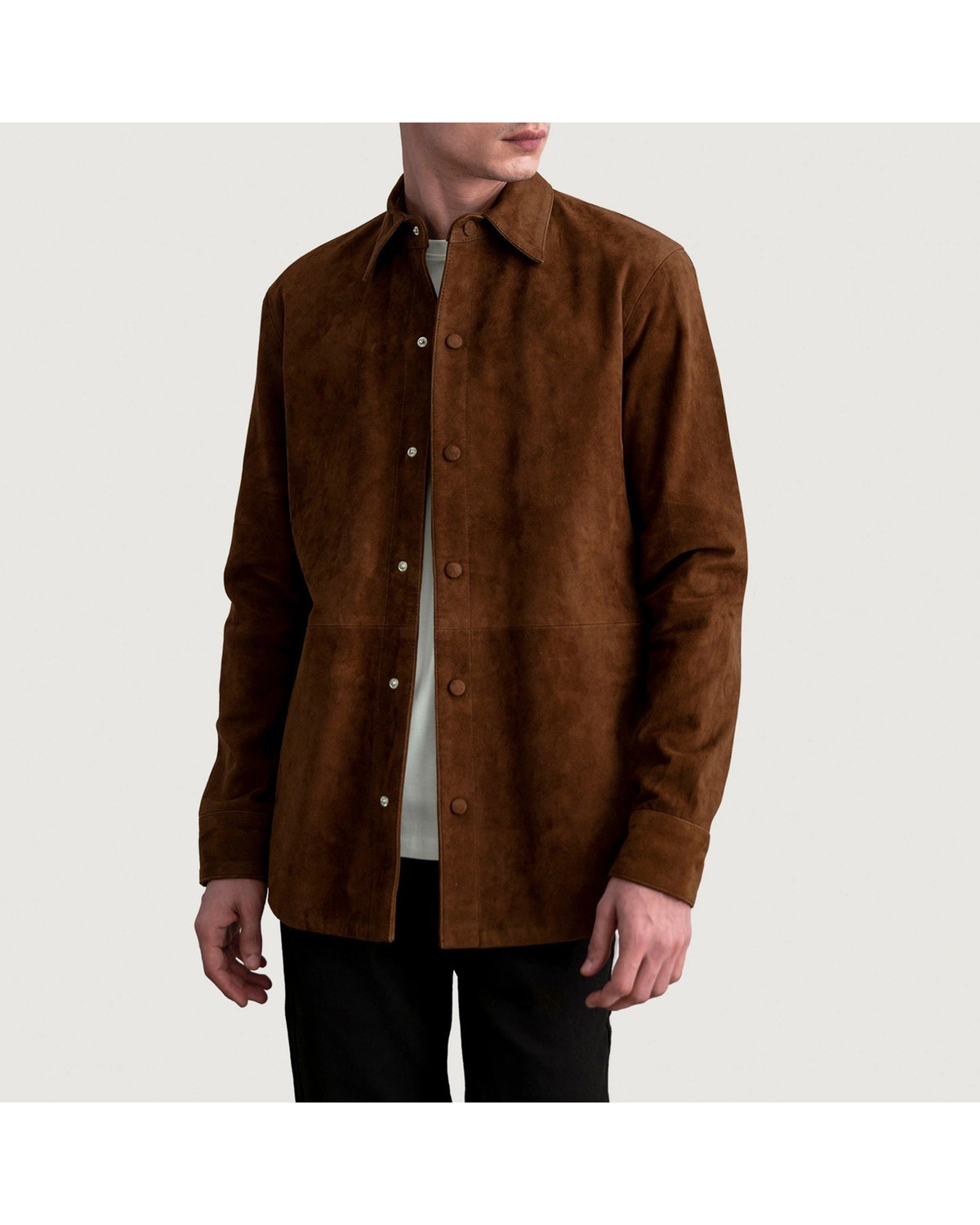
The only brown suede shacket you can order today
The Jacket Maker Haven Brown Suede Leather Shirt
This is the jacket that made the overshirt section possible. Everything else in the shape, in brown, from a retailer we can actually use, is sold out. This one is made to order, so it ships when it's made rather than from a shelf.
The spec sheet is unusually literal: outer shell, leather type, leather finish, each on its own line. Goatskin with a suede finish is exactly the right hide for a shirt cut, because it's thin enough to hang like a shirt instead of standing away from you.
You're waiting on production rather than shipping, so build in the lead time before you need it. The upside is that made-to-order sizing tends to be more forgiving than buying the last size left on a clearance rack.
You want a brown suede overshirt this season and you can wait for it.
You need it next week.
The Label
The Label
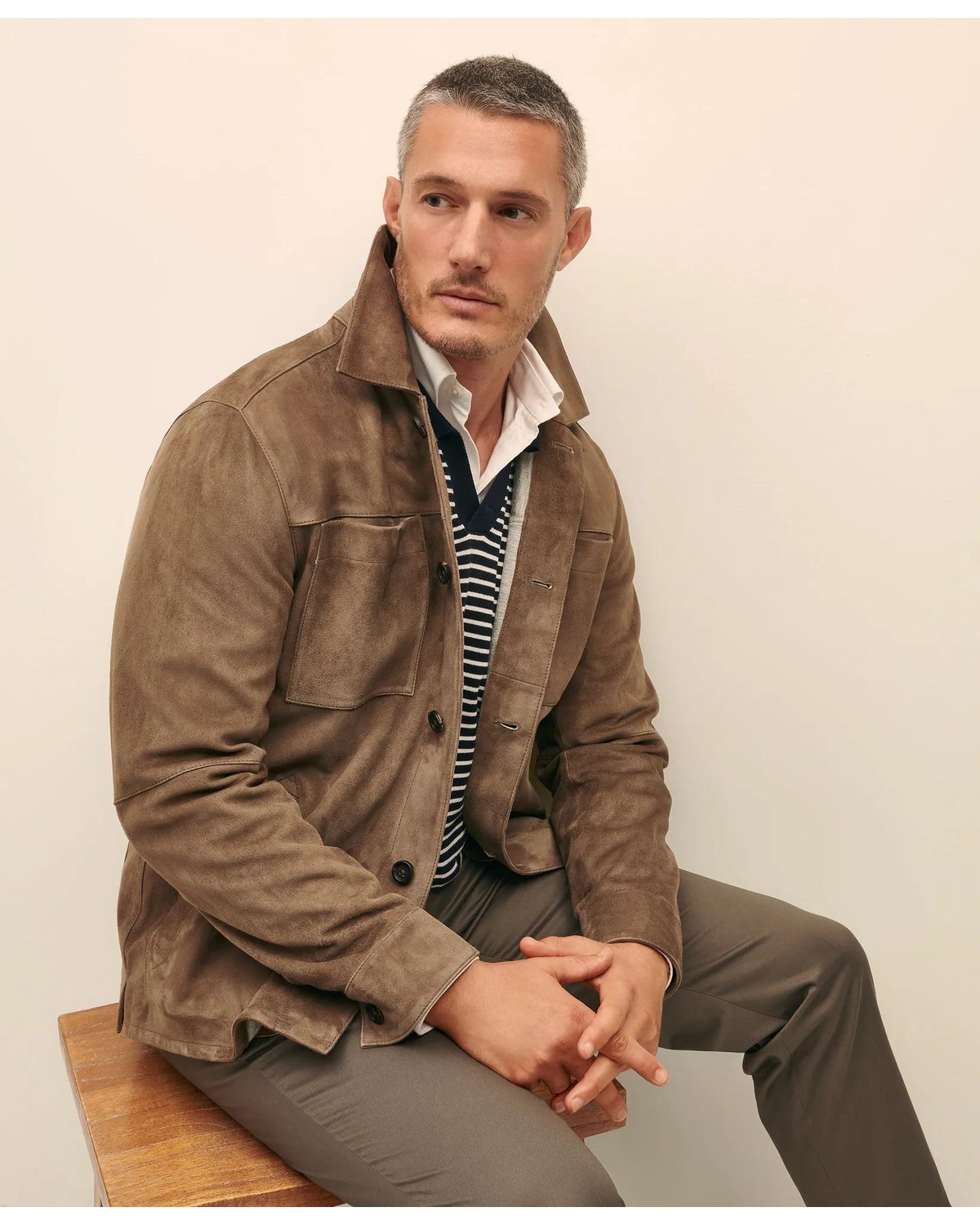
The biggest discount, the thinnest label
Brooks Brothers Suede Shirt Jacket
70% off is a real discount, and a brown suede overshirt in stock is a genuinely hard thing to find right now, so this earns its slot. It's also the clearest example on the page of the problem this guide is about.
100% Suede is the entire composition statement. Not the animal, not the layer. Their own perforated bomber, same store, same season, says goat. There's no rule that makes them fill this in, so on this jacket they didn't, and you're buying on the name.
Most commercial suede is the split, and a shirt-weight jacket at this price is most likely goat or cow. That's an educated guess, not information, and we'd rather tell you it's a guess than dress it up.
You want the shape in brown, now, at a real discount, and the label gap doesn't bother you.
Knowing what you're buying is part of what you're paying for.
The Label
The Label
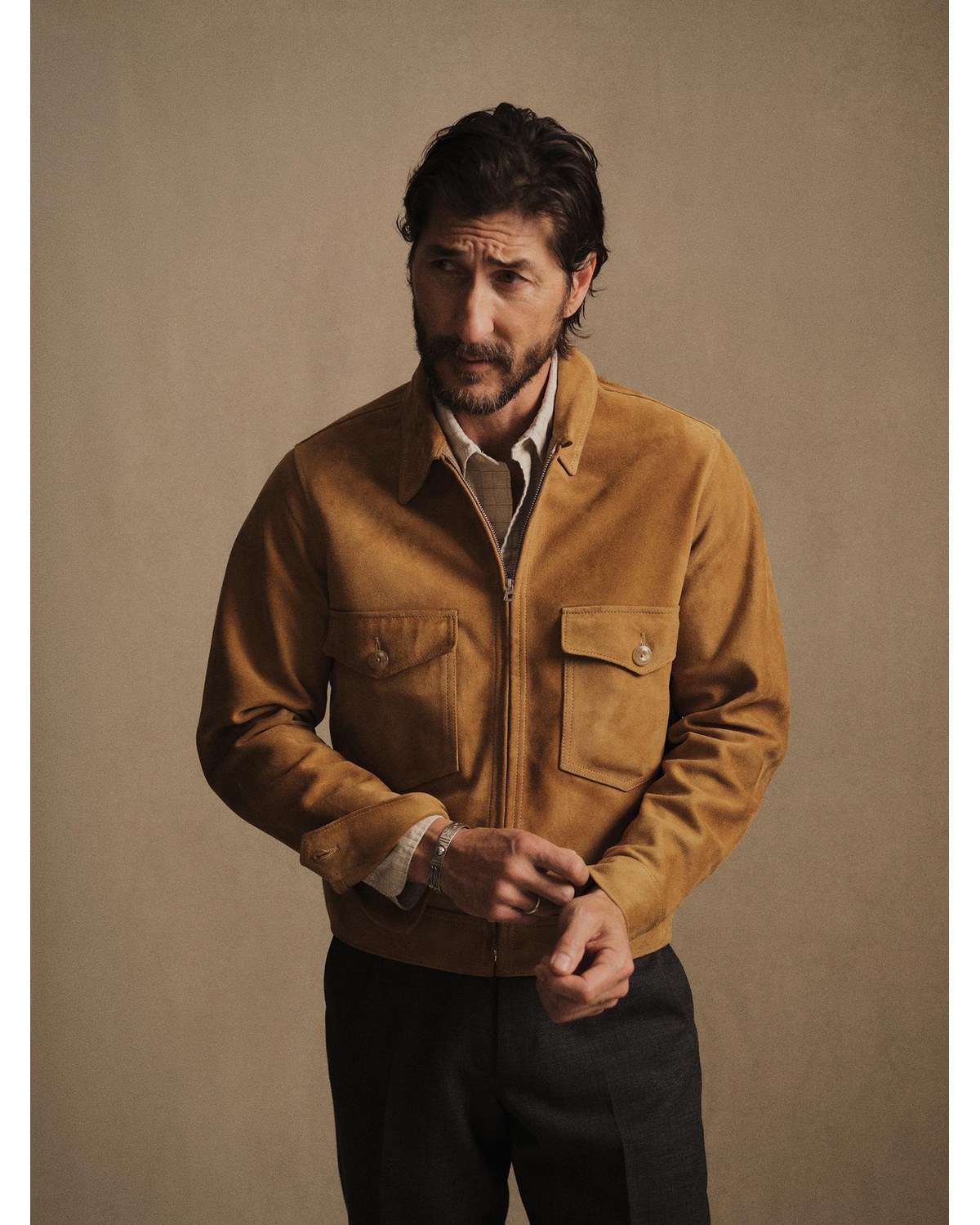
The best-documented hide on the page
Buck Mason Mojave Suede Station Jacket
Four separate facts in one line: the animal, the layer, how it was tanned and how it was colored. Nothing else in this guide comes close, and the specificity is the reason it's here rather than a cheaper overshirt.
Full-grain lambskin is a genuinely unusual combination. Lamb is the softest hide, full grain is the strongest layer, and putting them together gets you most of lamb's hand without as much of lamb's fragility. Vegetable tanning is why it'll darken and patina rather than just wearing out.
Veg tanning uses plant tannins instead of chrome salts, and it's the reason this jacket will look different in three years. It also means water marks it more readily than a chrome-tanned suede, so this is the one to spray and to keep out of the rain.
You care about what you're buying and you want the jacket that rewards that most.
You want low maintenance. Veg-tanned lamb is the highest-attention piece here.
The Label
The Label
Both of these are the jacket this section is short of, and both are gone. The pages are still live, so a restock notification is worth setting.
Unlined goat suede in the exact shirt cut this section is short of. Every one of Taylor Stitch's nine suede jackets is sold out right now, pages still live.
The cheapest real-suede overshirt we found anywhere, in dark brown, from a specialist. Worth setting a restock alert on.
Field cuts and one statement piece
Longer, roomier, more pockets. This group holds both ends of the guide, the cheapest real suede on the page and the most expensive.
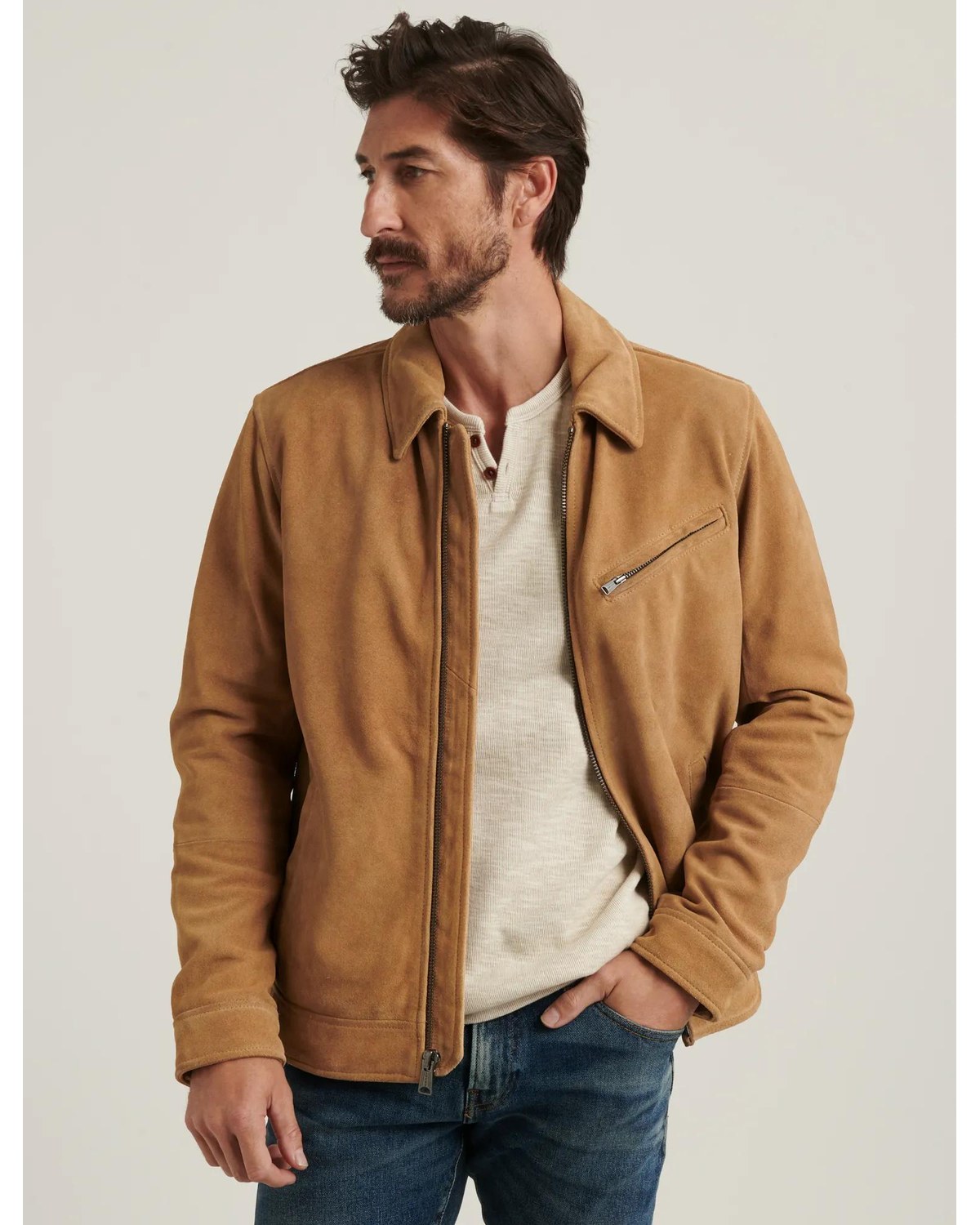
Real cow suede, under a hundred
Lucky Brand Suede Riding Jacket
The cheapest real suede in this guide, and it isn't close. Cow suede, named on the tag, in a tan the brand calls Toasted Coconut, with the full size run still live. At $99.99 it costs less than two of the faux jackets further down.
Cow is the toughest hide here, which at this price is the right trade. You're not getting the drape of lamb or the fineness of calf. You're getting the one that survives being treated like a normal jacket.
If you've never owned suede and you're not sure you'll wear it, this is the one to find out with. Cow is the most forgiving of the mistakes people make with suede, and at this price a mistake isn't expensive.
You want to try suede without committing, or you want a beater that happens to be real.
You want something that feels expensive. This feels like what it costs, in a good way.
The Label
The Label
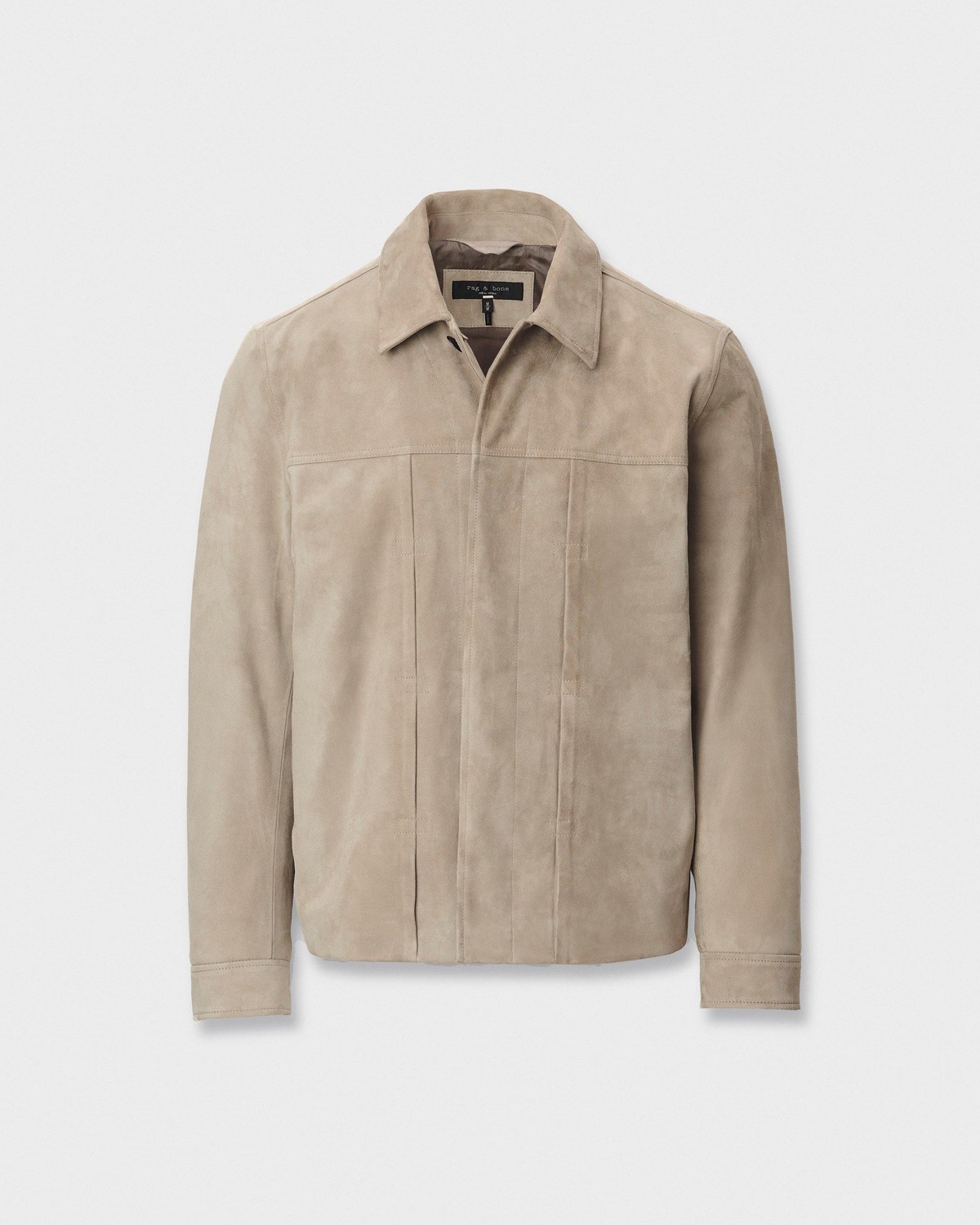
Design first, label second
rag & bone Dwight Suede Jacket
The Dwight is the most designed thing in this guide. A pleated front, a relaxed field shape and a brown they call Mink that sits between taupe and chocolate depending on the light. If you want the jacket people ask about, this is it.
The composition line says 100% suede and nothing else, which from a brand at this price is a choice rather than an oversight. They'll tell you the lining is 52% polyester and 48% viscose, so the detail exists when they want it to.
It's worth noticing when a brand gives you exact percentages for the lining and one word for the leather. The information isn't missing because it's hard to get.
You want a suede jacket with an actual point of view, and you're buying the design.
You've read this far because you want the spec. This one won't give it to you.
The Label
The Label
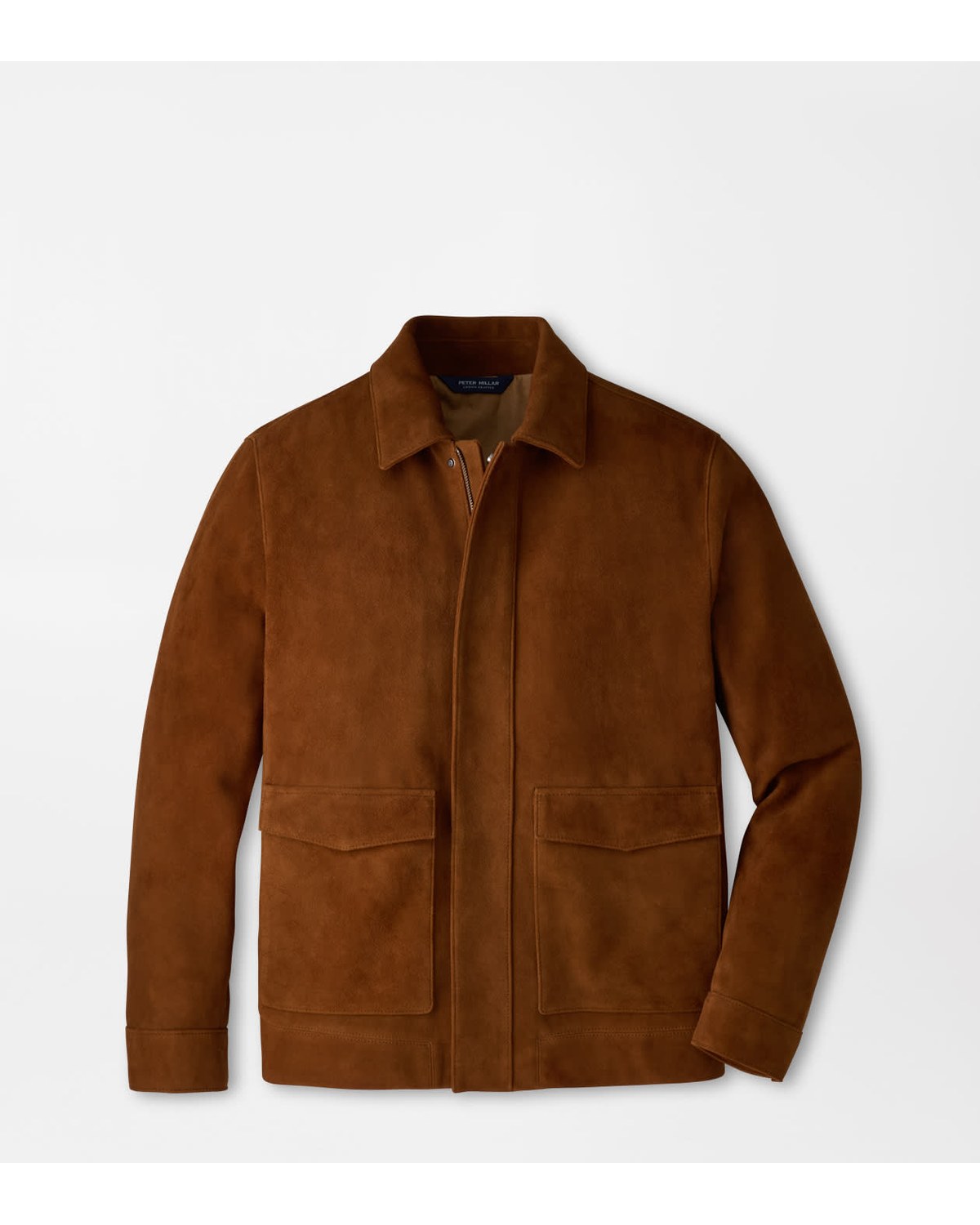
The only deerskin on the page
Peter Millar Deerskin Suede Jacket
Every other jacket in this guide is goat, cow, lamb, calf or nothing stated. This one is deerskin, and it's the reason the top of the price ladder is interesting rather than just expensive. Peter Millar names the animal, the continent and both lining fibers.
Deerskin's reputation is for staying soft and moving with you rather than resisting you. We'll be straight that this is what the trade says rather than something we found measured in the leather-science literature, unlike the claims we make about lamb and goat.
Not durability. Cow outlasts deer. What it buys is a hide almost nobody else is cutting jackets from this season, a flannel-and-lyocell lining, and a tailored fit rather than a boxy one.
You want the piece nobody else in the room is wearing and you've got the budget.
You're comparing on specifications. On paper the Quince bomber is better value seven times over.
The Label
The Label
Faux suede, labeled honestly
Not leather, and every one of these says so on the tag. Worth a look if you want the color and the silhouette without the care routine or the price.

The whole look for $36
COOFANDY Suede Bomber Jacket
Thirty-six dollars, five colors, three of them brown. It's polyester and the listing says polyester, which is all we ask of a faux jacket. Nobody's being misled here.
What you're buying is the silhouette and the color. What you're not buying is the nap that catches light differently as you move, or a jacket that looks better in year three than year one. Polyester looks the same until it doesn't.
Run your thumb across it against the grain. Real suede shifts color where you've brushed it and holds that mark until you brush it back. Polyester barely moves. It's the fastest way to tell them apart in a shop.
You want to try the look for the price of lunch, or you need something you can genuinely stop worrying about.
You want it to age. It won't.
The Label
The Label
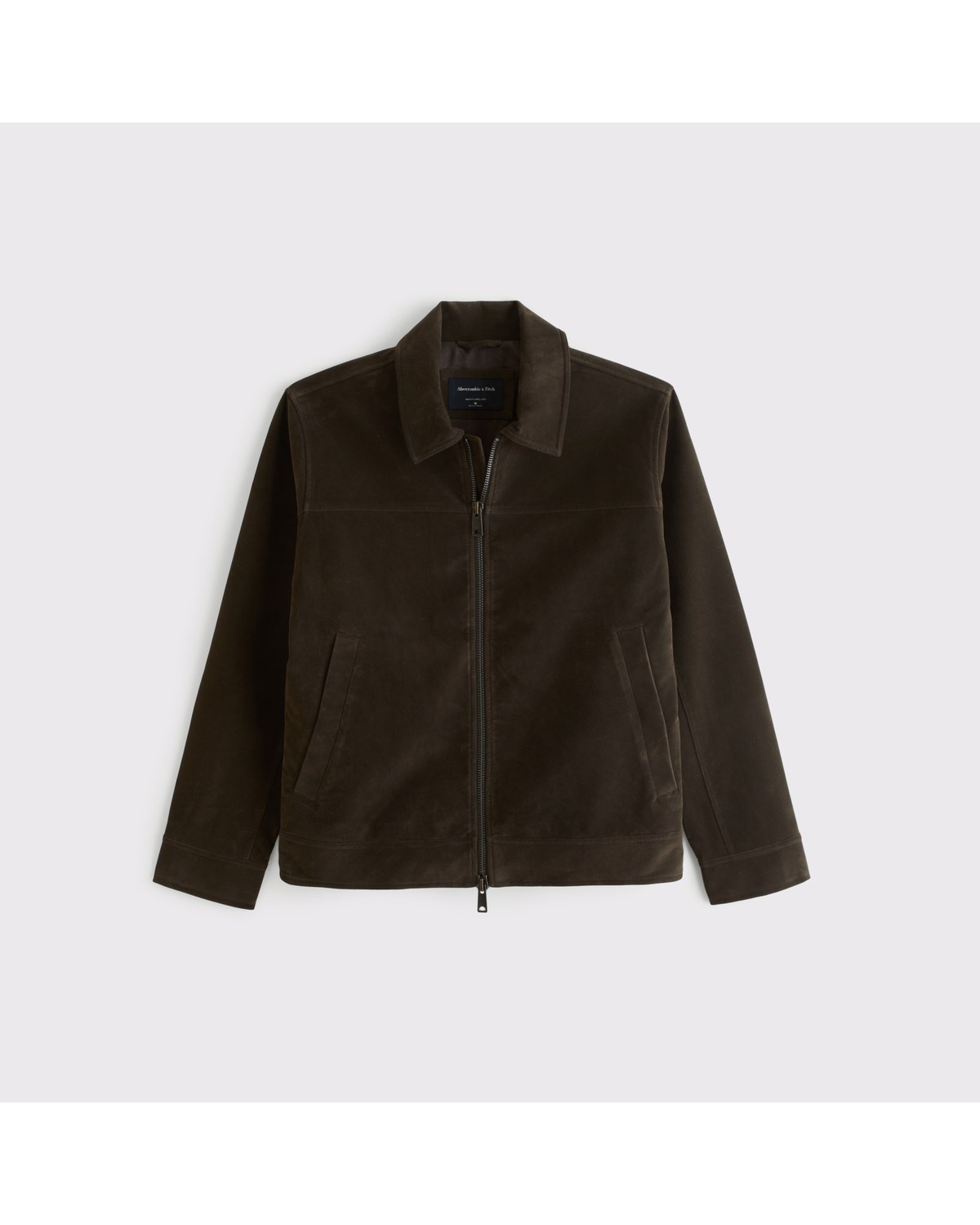
Viscose, which behaves differently
Abercrombie Easy Vegan Suede Zip Trucker Jacket
Abercrombie itemizes this one down to the backing, and the interesting detail is that the face is viscose rather than polyester. Viscose is made from wood pulp, so it takes dye deeper and hangs heavier than a polyester face does.
In practice it's the faux jacket that comes closest to reading as real from across a room, and it's cut as an actual trucker rather than a bomber with flap pockets stuck on it. Zip front rather than snaps, which is the one giveaway.
Wood-pulp fibers lose strength when they're wet in a way polyester doesn't, so this is the faux jacket to keep out of the rain. The irony of a fake suede that dislikes water as much as the real thing isn't lost on us.
You want the trucker shape in brown and you'd rather spend $120 than $300.
You wanted faux specifically because it shrugs off weather.
The Label
The Label
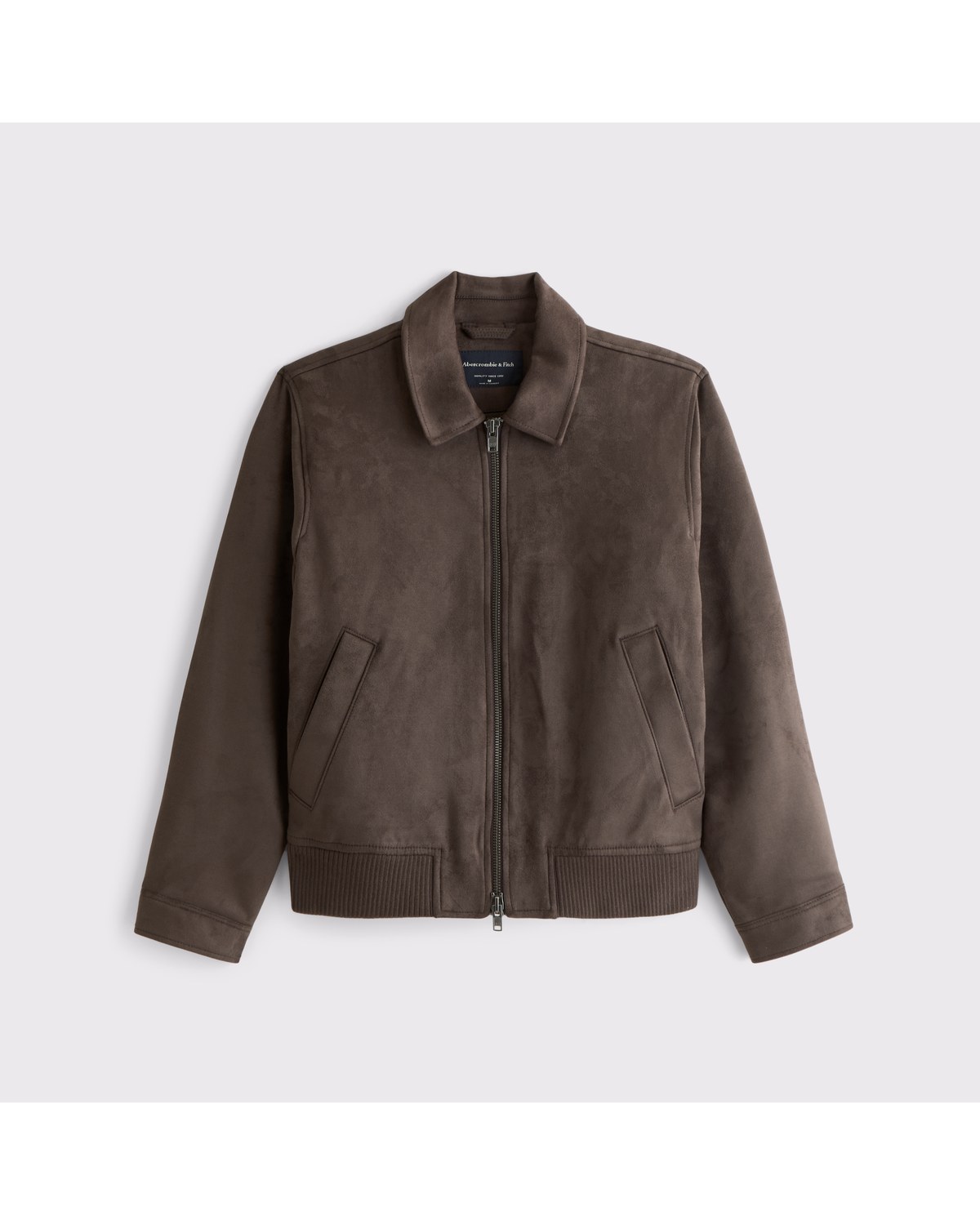
The only insulated jacket here
Abercrombie Vegan Suede Bomber Jacket
Every other jacket in this guide is a shell with a lining. This one has a recycled polyester fill between the two, which makes it the only genuinely warm thing on the page and the only one you could wear in January without a layer underneath.
The 10% elastane in the face is why it moves the way it does. Real suede has no stretch at all, so if you've been put off by how restrictive a suede jacket feels across the shoulders, this solves a problem the expensive ones can't.
No hide stretches. If a jacket described as suede gives when you reach forward, there's elastane in it, which means there's no leather in it. Abercrombie states it plainly here, but it's a useful check anywhere.
You want warmth and movement, and the look matters more than the material.
You want the real thing. At $165 you're within reach of the Quince bomber.
The Label
The Label
How to wear it
Three outfit formulas that work
Suede does most of the work, so everything around it should be plain. These are the three combinations worth learning.
The one that reads as deliberate
Suede on top, leather on the feet, and nothing shiny in between. A relaxed-straight trouser with a full break covers enough of the shoe that the loafer reads as a choice rather than a formality. Keep the shirt plain and let the jacket be the only texture in the outfit.
- Trouser Relaxed straight, mid-rise, in wool or a heavy cotton. Not tapered, the whole point is that the leg falls straight over the shoe.
- Shoe A penny or horsebit loafer in a leather that contrasts your jacket. Brown suede jacket, darker brown or black shoe.
- Between A plain crew or a fine-gauge knit. No collar competing with the jacket's.
- Avoid Matching your shoe to your jacket exactly. Two browns that are close but not identical look like an accident.
Side by side
Compare all seventeen
Tap a column heading to sort. Cheapest first by default.
| Jacket ▴▾ | Price ▴▾ | Hide ▴▾ | Layer ▴▾ | What the label says ▴▾ | Cut ▴▾ |
|---|---|---|---|---|---|
| COOFANDY Suede Bomber Jacket | $35.99 | Not leather | Not applicable | Not leather | Faux |
| Lucky Brand Suede Riding Jacket | $99.99 | Cowhide | Layer not stated | Animal only | Field |
| Abercrombie Easy Vegan Suede Zip Trucker Jacket | $120 | Not leather | Not applicable | Not leather | Faux |
| Lucky Brand Suede Trucker Jacket | $149.99 | Goatskin | Layer not stated | Animal only | truckers |
| Abercrombie Vegan Suede Bomber Jacket | $165 | Not leather | Not applicable | Not leather | Faux |
| Desired Jackets Real Lambskin Suede Jacket | $179.99 | Lambskin | Layer not stated | Animal only | bombers |
| Quince 100% Suede Bomber Jacket | $200 | Goatskin | Grain side, named | Animal and layer | bombers |
| The Jacket Maker Haven Brown Suede Leather Shirt | $295 | Goatskin | Layer not stated | Animal only | overshirts |
| Quince Italian Suede Trucker Jacket | $300 | Cowhide | The split, named | Animal and layer | truckers |
| Brooks Brothers Suede Shirt Jacket | $359.99 | Not stated | Layer not stated | Neither named | overshirts |
| Brooks Brothers Perforated Suede Bomber Jacket | $399.99 | Goatskin | Layer not stated | Animal only | bombers |
| AllSaints Kemble Suede Bomber Jacket | $455 | Goatskin | Layer not stated | Animal only | bombers |
| Overland Jimmy Suede Leather Jacket | $495 | Goatskin | Layer not stated | Animal only | truckers |
| rag & bone Dwight Suede Jacket | $700 | Not stated | Layer not stated | Neither named | Field |
| Buck Mason Mojave Suede Station Jacket | $798 | Lambskin | Grain side, named | Animal and layer | overshirts |
| Todd Snyder Italian Suede Dylan Jacket | $998 | Calfskin | Layer not stated | Animal only | truckers |
| Peter Millar Deerskin Suede Jacket | $1,995 | Deerskin | Layer not stated | Animal only | Field |
Hide and layer show what each brand commits to. A blank in either column is the brand's doing, not ours.
Looking after it
What conservators actually recommend
Most suede care advice online contradicts the people whose job is keeping leather intact for a century. Here's what the museum guidance actually says.
- Brush it, and that's mostly it. A moderately stiff brush lifts surface dirt and brings the nap back up. The Canadian Conservation Institute recommends exactly this for suede, and warns against powdered erasers because the residue is very hard to get back out.
- Don't condition it. This is the big one. Both the CCI and the National Park Service museum handbook advise against leather dressings and saddle soap. The oils oxidize, stiffen the material over time, and attract dust you can't then remove.
- Blot water, never rub it. Rubbing mats the nap and drives the dye. Blot, then let it dry away from any heat source, then brush the nap back once it's completely dry.
- A spray buys time, not immunity. Fluoropolymer and silicone treatments lower the surface energy so water beads instead of soaking in. That's repellency. It wears off, it needs reapplying, and it doesn't make suede waterproof whatever the can says.
- Store it on a wide hanger, with air. Stable humidity matters more than any product, somewhere in the 45% to 55% range. Keep it off a radiator and out of a damp basement, and give it room rather than crushing the nap between two coats.
Questions
Suede, answered properly
Is split suede worse than full grain suede?
Not worse, just different, and it's most of what's sold. A hide gets sliced into layers. The outside is the grain, where the fibers are densest, and everything underneath is the split. Suede is made by buffing a nap onto a surface, and the University of Cincinnati's leather lab is clear that most commercial suede starts from the split rather than the grain. So a brand saying split suede is describing the normal thing accurately. The ones worth a second look are the brands that say nothing at all.
What's the difference between suede and nubuck?
Which side got sanded. Suede is buffed on the flesh side, the inside of the hide, which is why the nap is longer and softer. Nubuck is buffed on the grain side, the outside, so the nap is much shorter and the material underneath is stronger. Nubuck can't be made from a split at all, because a split has no grain side left. That's why nubuck usually costs more and takes weather better.
Does rain actually ruin suede?
It's overstated. What happens is that the nap mats down and, as the wet patch dries, dye migrates to the edge and leaves a darker ring. Both of those are cosmetic and both are usually reversible. Blot the water out rather than rubbing it, let the jacket dry away from any heat source, then bring the nap back with a suede brush once it's completely dry. What does real damage is saturating it repeatedly, or drying it fast on a radiator.
Do waterproofing sprays work on suede?
They help, and they don't do what the label implies. A fluoropolymer or silicone spray lowers the surface energy so water beads and rolls off instead of soaking in. That's water repellency, not waterproofing, and the effect wears off with use and needs reapplying. It buys you time to get indoors and it reduces staining. It doesn't make a suede jacket a rain jacket.
What does “genuine leather” mean on a label?
Less than it sounds like. It isn't a quality grade and no US rule defines it as one. Canada's Competition Bureau puts it plainly: genuine leather generally describes leather that isn't top grain or full grain, and it's often split leather. What US law does cover, under the FTC's leather guides, is the other direction. A product that isn't leather has to say so, and something made from ground or bonded leather fiber can't be sold as leather at all.
Should I condition a suede jacket?
No. This is the one piece of common advice that conservators actively contradict. Both the Canadian Conservation Institute and the National Park Service museum handbook advise against leather dressings and saddle soap, because the oils oxidize, stiffen the material over time and attract dust that can't be removed afterward. For suede specifically the recommendation is a moderately stiff brush and nothing else. The CCI also warns off powdered erasers, since the residue is very hard to get out of a nap.
Which hide should I actually buy?
For one jacket that has to do everything, goat. It's thin enough to drape, its fibers interweave tightly enough to take daily wear, and it doesn't need the break-in period cowhide does. Cow if it's going to get treated roughly, lamb if softness matters more than longevity, calf if you want it to hold a shape. Nine of the jackets here name their animal, and goat is the most common answer.
Is faux suede a reasonable buy?
For some people, yes, and the honest version of the pitch is about cost and care rather than performance. Faux suede is polyester or viscose fiber on a backing, usually polyurethane. It shrugs off water, it costs a fraction, and it won't stretch out at the elbows. What it can't do is develop the burnish real suede gets, and polyurethane-backed material has a failure mode leather doesn't: as the binder ages it can crack or peel. Every faux jacket on this page states its fiber content, which is what the FTC guides are for.
How can I tell real suede from faux in a shop?
Two checks, five seconds each. Run your thumb across the surface against the nap. Real suede changes color where you've brushed it and keeps that mark until you brush it back, and faux barely moves. Then pull the fabric gently. No hide stretches, so if it gives, there's elastane in it and there's no leather in it.
What does a jacket's weight in ounces mean?
It's a thickness measurement, and the conversion is fixed: one ounce is one sixty-fourth of an inch. So a 3 oz suede is three sixty-fourths of an inch, which is about 1.2 mm, roughly the thickness of a credit card. Garment suede usually runs somewhere around 2 to 3.5 oz. Anything much heavier is boot or bag leather and would hang like armor on a jacket.
Method
How we put this together
How we graded them
Two questions settle it. Does the brand name the animal, and does it name the layer. Where a brand answered neither, we scored it that way rather than filling the gap ourselves, even where the trade would bet on goat.
Stock checked, not assumed
Twelve retailers that sell suede had nothing buyable, so they aren't here. Two jackets are listed as sold out because they're the right jacket and we'd rather say so than pretend the market is deeper than it is.
Material claims sourced
Structure and care claims come from the sources below, not from retailer copy. Where something is trade consensus rather than documented, deerskin's softness for instance, the page says so.
